California's SB 375 attempts to require cities to develop in a way that reduces greenhouse gas emissions. But some cities say the new law is misguided, and the state should focus on zero-emission vehicles instead.


"The most public attack so far came last week from Ty Schuiling, planning director for the San Bernardino Associated Governments – a group of local governments that can be expected to be hostile to SB 375's goals. At a conference last week, Schuiling challenged the idea that land use changes are required to meet the state's greenhouse gas reduction goals because the goal cannot be met by making cleaner vehicles, as the California Air Resources Board has suggested. "That is simply not true," Schuiling said.
A similar but more subtle argument came from Hasan Ikhrata, the executive director of the Southern California Association of Governments, which is charged with implementing SB 375 in the Los Angeles region. Speaking on the same panel as Schuiling, Ikhrata said: "I don't think 375 should be thought of as a global warming bill. I don't think it's the most cost-effective way to reduce GHG emissions. When I speak about 375 I speak about a land use bill, an urban form bill.""
Read the full story: Locals Attack SB 375 As Inefficient Way To Go After Climate Change


California’s Cap and Trade Program Up in the Air
The state’s carbon trading program is being attacked as ineffective from one side and overly onerous from the other.
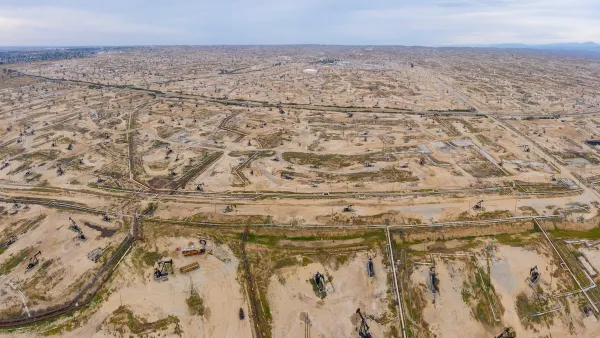
California County Approves Underground Carbon Storage Project
Kern County supervisors voted to support a carbon storage project that will inject climate-warming gases into a former oil and gas field.

Providence Could Ban New Gas Stations
The city could prohibit the construction of new fueling stations within city limits to discourage driving and pave the way for more renewable transportation infrastructure.

Planetizen Federal Action Tracker
A weekly monitor of how Trump’s orders and actions are impacting planners and planning in America.

California plans to bury El Niño’s downpour
If the state plays its cards right, it may be able to store a billion acre-feet of El Niño’s water in aquifers.

Chicago breaks ground on $3 billion megadevelopment
The new neighborhood, titled Foundry Park, will one day host 3,700 residences.

City officials are dumping billions of gallons of sewage into the Chicago River
This year, the Racine Avenue sewage pumping station has poured over 10 billion gallons of sewage into the Chicago River.

Move over, LA: St. Louis gears up for Olympics, invests millions in downtown redevelopment
The Missouri city will host the 2028 Olympic soccer group stage and knockout matches.

Satanic place names
From streams and lakes to valleys and canyons, I mapped more than 1,000 places named after the Devil.

FREE Course: Walkable City 1: Why Walkability?
After describing his path towards focusing on walkability as the essence of good planning, Jeff Speck marches through his five principal reasons for making more walkable places.
Reinventing Malls: Planning Alchemy—Turning Gray Fields Into Gold
The course focuses on the opportunities and imperatives that shape reinvention of mall sites.

City of Rosemead
Rutgers University, Edward J. Bloustein School of Planning and Public Policy
One Hundred Miles
Hunter College, City University of New York (CUNY)
The Architects Foundation
University of Cincinnati Online
City of Cambridge
Montrose County
The Pocatello Development Authority