This segment form Oregon Public Broadcasting looks at the rise of wind farms in rural Oregon.


"Companies like GE and Seimens make turbines; the federal government offers utilities big financial incentives to build wind farms; and as Kristian Foden-Vencil reports, hundreds of windmills have gone up in Oregon alone."
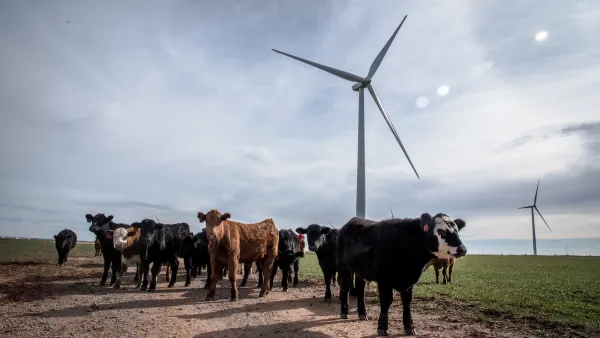
"Gary Hackett: 'The land in Sherman County is basically dry land farming. And the population of the whole county is 1800 people. So the wind farm has brought tremendous opportunity to the area in the form of jobs, opportunities for folks to get a new career path and stay home.'"
"Plus, farmers can get $6,000 a year or more for each turbine. And while these truly are massive machines, their footprint is small -- about the size of a shed -- meaning farmers can still work the land."
"In an effort to reduce reliance on foreign oil -- and to battle climate change -- Oregon has told utilities that a quarter of their power needs to come from renewables by the year 2025."
Read the full story: Wind Power: A Very Green But Very Intermittent Source Of Power
Renewable Energy Overtakes Coal for First Time
Solar and wind power generated close to a third of U.S. electricity supplies in 2024.

New York Offshore Wind Farm Offers Hope for Nascent Industry
The first commercial-scale offshore wind installation in the United States is powering roughly 70,000 homes in Long Island, New York.

Study Assesses How Wind Farms Affect Property Values
A new study shows that wind farms have a small but temporary negative impact on nearby property prices.

Planetizen Federal Action Tracker
A weekly monitor of how Trump’s orders and actions are impacting planners and planning in America.

California plans to bury El Niño’s downpour
If the state plays its cards right, it may be able to store a billion acre-feet of El Niño’s water in aquifers.

Desperate measures: Advocates weigh draining Lake Powell to fill Colorado River
Draining the reservoir could reduce evaporation losses by a couple hundred thousand acre-feet.

Los Angeles just elected an urban planner as its mayor
Transportation analysts are optimistic that Raman will be more aggressive in addressing transit issues than Bass.

Mamdani’s pied-à-terre tax survives legal challenge
A panel of judges found that the plaintiffs failed to demonstrate injury as a result of New York City's implementation of the tax.

Eastern Nebraska is running out of electricity
Data centers and electrification are straining eastern Nebraska’s grid, throttling economic development.

FREE Course: Walkable City 1: Why Walkability?
After describing his path towards focusing on walkability as the essence of good planning, Jeff Speck marches through his five principal reasons for making more walkable places.
Reinventing Malls: Planning Alchemy—Turning Gray Fields Into Gold
The course focuses on the opportunities and imperatives that shape reinvention of mall sites.

City of Rosemead
Rutgers University, Edward J. Bloustein School of Planning and Public Policy
One Hundred Miles
University of Michigan School for Environment and Sustainability (SEAS)
Hunter College, City University of New York (CUNY)
The Architects Foundation
City of Cambridge
Montrose County
The Pocatello Development Authority