Governors Rendell and Schwarzenegger are imploring President Obama to take the lead on national infrastructure policy, rather than allowing earmarks to guide projects.


"At a meeting with the president last month, the two governors and New York Mayor Michael R. Bloomberg discussed the memo they had sent to the White House, a draft of which reads: 'It is very important that the administration be proactive rather than left reacting to congressional proposals.'"
"In the coming months, Congress will consider a bill to set aside as much as $450 billion for highway and other infrastructure projects over a span of six years. House aides said members of Congress intended to insert special projects, or earmarks, into the bill, despite warnings from Obama that he wanted to rein in such spending."
"As yet, the Senate has not decided how it will handle earmarks in the bill, said an aide to Sen. Barbara Boxer (D-Calif.), chairwoman of the Environment and Public Works Committee."
"Rendell cautioned in an interview that if the bill was larded with earmarks, it could jeopardize the political consensus needed to modernize the nation's network of roads."
FULL STORY: Obama is urged to take the wheel on infrastructure


Congress Introduces Bill to Limit Size of SUVs and Trucks
Lawmakers want the federal government to set standards for vehicle height and visibility to combat the sharp rise in pedestrian deaths over the past decade.

Undoing Biden's EV Rule
The partisan divide over how government should reduce greenhouse gas emissions was on full display after the Biden administration finalized its emissions standards rule for light and medium duty vehicles on March 20.
Brookings: A Demographic Post-Mortem of the Midterms
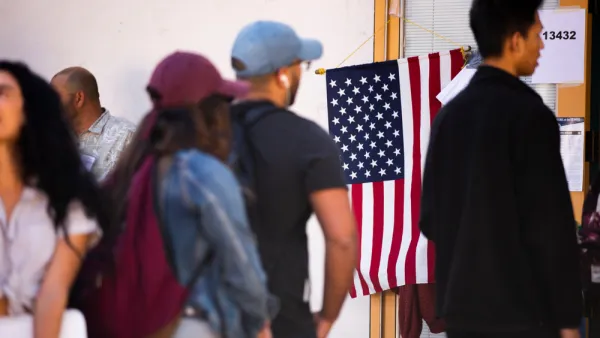
Young adults, according to a deep dive analysis by Brookings Metro demographer William Frey, were a key demographic group responsible for stopping the red wave that most polling predicted as the likely outcome of last month's midterm elections.

Planetizen Federal Action Tracker
A weekly monitor of how Trump’s orders and actions are impacting planners and planning in America.

The state-sanctioned urbicide of Austin
People don’t kill cities. Freeways do.

US to reduce Colorado River water deliveries to Mexico
A new Colorado Treaty amendment reduces Mexico’s Colorado River water allocation by 250,000 acre feet.

LA Metro’s ultimatum: no extra buses for LA28 if federal funding isn’t imminently secured
If Metro does not provide additional buses, LA28 organizers will have to find a new way to manage Olympic traffic. LA28’s budget does not include a line item for transit.

Colorado’s Largest Data Center Could Rise Next to Homes — Without a Public Hearing
The proposed campus would consume 11 times the power of Denver International Airport; as it has across the country, opposition mounts.

5 New England states march closer to 800 megawatt wind energy project
Securing federal approval for the project may be complicated under the Trump administration, which has historically been hostile towards domestic wind power.

FREE Course: Walkable City 1: Why Walkability?
After describing his path towards focusing on walkability as the essence of good planning, Jeff Speck marches through his five principal reasons for making more walkable places.
Reinventing Malls: Planning Alchemy—Turning Gray Fields Into Gold
The course focuses on the opportunities and imperatives that shape reinvention of mall sites.

Eagle County Government
Harvard University Graduate School of Design
Nashville Planning Department
The Architects Foundation
University of Cincinnati Online
The Pocatello Development Authority
The Urban Renewal Agency of the City of Pocatello
Journal of the American Planning Association