An L.A. Times investigation reveals that HUD's 10-year-old Dollar Homes program provided little lasting benefit to the intended recipients and significant rewards to investors and contractors.


"More than 2,300 homes have been sold by HUD for $1 each nationwide, with 326 in California. Nearly half of the homes in California were bought by companies or individuals who typically resold them at a much higher price. Only 15% were sold to nonprofit housing groups such as Habitat for Humanity, records show.
The city of San Bernardino bought more Dollar Homes -- 62 -- than any other city or county in the state. But San Bernardino officials could not provide The Times with any account of what happened to the homes after they were sold.
"They went back to the private market, and hopefully they were maintained and kept up," said Carey Jenkins, the housing director of San Bernardino's economic development agency, which oversees the city's Dollar Homes purchases. "And that was pretty much the end of our involvement.""
Read the full story: HUD's Dollar Homes falls short of mission

Analysis: ROAD to Housing Act could take years to implement
HUD is tasked with implementing nine new rules as part of the ROAD to Housing Act — while operating with a significantly reduced staff.

How HUD is dismantling fair housing enforcement
Fair housing law has never been easy to enforce. But HUD's proposal to eliminate the use of disparate impact analysis will remove another crucial tool for doing so.
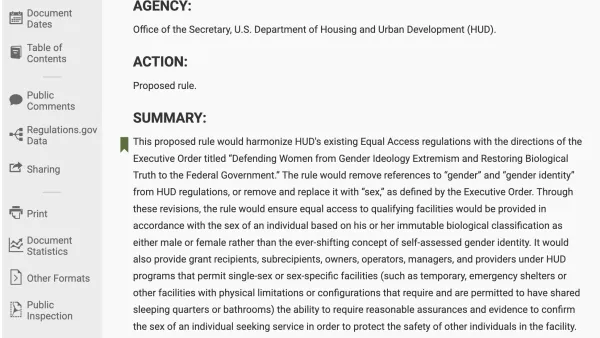
New HUD rule would remove gender from housing protections
The proposal in the federal registry would replace “gender” and “gender identity” with “sex” as defined by Trump’s January, 2025 executive order.

Planetizen Federal Action Tracker
A weekly monitor of how Trump’s orders and actions are impacting planners and planning in America.

California plans to bury El Niño’s downpour
If the state plays its cards right, it may be able to store a billion acre-feet of El Niño’s water in aquifers.

Desperate measures: Advocates weigh draining Lake Powell to fill Colorado River
Draining the reservoir could reduce evaporation losses by a couple hundred thousand acre-feet.

US buildings threatened, destroyed by fires set to triple by 2060
Researchers found a high fire risk for socioeconomically vulnerable neighborhoods in the American West.

LA residents may be allowed to paint their own crosswalks
Councilwoman Katy Yaroslavsky put out a motion instructing the Los Angeles Department of Public Transportation to study the feasibility of allowing volunteers to paint crosswalks.

Dallas moves to overhaul its zoning code
The city's zoning reform will allow more multi-family and mixed-use developments.

FREE Course: Walkable City 1: Why Walkability?
After describing his path towards focusing on walkability as the essence of good planning, Jeff Speck marches through his five principal reasons for making more walkable places.
Reinventing Malls: Planning Alchemy—Turning Gray Fields Into Gold
The course focuses on the opportunities and imperatives that shape reinvention of mall sites.

City of Rosemead
Rutgers University, Edward J. Bloustein School of Planning and Public Policy
One Hundred Miles
Hunter College, City University of New York (CUNY)
The Architects Foundation
University of Cincinnati Online
City of Cambridge
Montrose County
The Pocatello Development Authority