The housing market is struggling big time. Author Bill Morrish argues that salvation could be found in an unsuspected urban form: the trailer park.


"Now, with the housing market in shambles and Americans getting poorer by the minute, Morrish's mind has skipped ahead once again, this time to the trailer park as a model for new housing. Seriously."
"Morrish has never been interested in the form of a building in isolation. Rather, his talent lies in analyzing the complex web of relationships among buildings, humans and events. The 21st century has brought dramatic changes to that mix, especially in the housing market.
Homes nowadays must be smaller and cheaper. They must use energy more efficiently. Cars must be fewer and transit more available. Towns must be more compact, with stores and jobs closer. Housing types must be more varied to match changing demographics. Many homes, for example, must include independent spaces for aging parents or returning children. Immigrant homes must accommodate extended families. Many more people are single. Many more need live/work spaces. Landscaping is more important than ever. Water must be captured and recycled. Zoning and permitting processes must be streamlined. Creative financing is vital."
Read the full story: Hard times: The trailer park as a 21st-century housing model? Seriously.

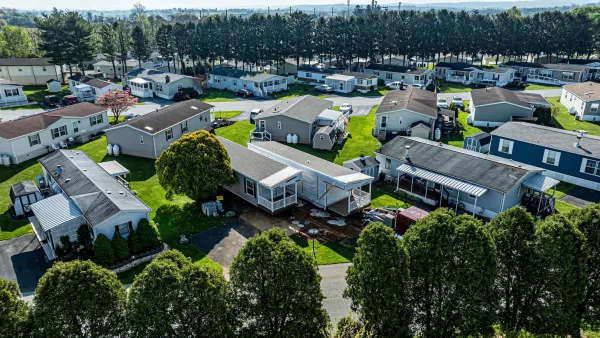
Should the public sector buy mobile home parks?
One writer argues that the crisis facing the nation's mobile home owners warrants public intervention.
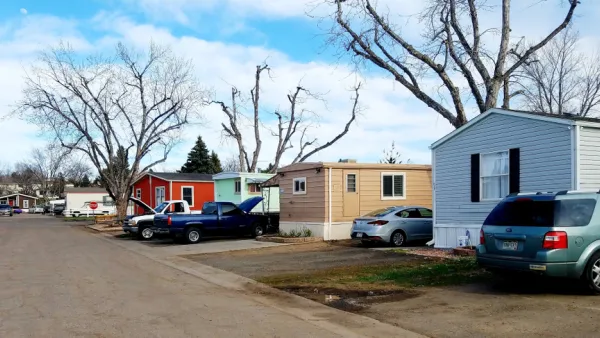
New Loan Fund Will Help Mobile Home Residents Purchase Land
A Colorado law makes it easier for residents to buy the mobile home parks they live in to protect against sharp rent increases.
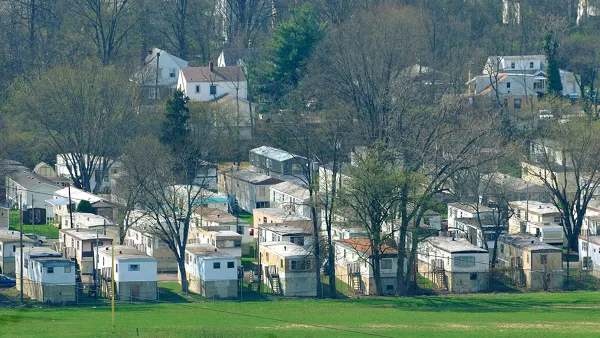
Mobile Home Residents Face Rising Displacement Threat
As investors continue to eye mobile home parks as a profitable opportunity, current residents, many elderly and low-income, face steep rent hikes and possible eviction.

Planetizen Federal Action Tracker
A weekly monitor of how Trump’s orders and actions are impacting planners and planning in America.

The state-sanctioned urbicide of Austin
People don’t kill cities. Freeways do.

US to reduce Colorado River water deliveries to Mexico
A new Colorado Treaty amendment reduces Mexico’s Colorado River water allocation by 250,000 acre feet.

Brightline West’s future may rely on $6 billion federal loan
The company has until Nov. 2 to make a $400 million equity investment into its proposed high-speed rail line.

LA Metro’s ultimatum: no extra buses for LA28 if federal funding isn’t imminently secured
If Metro does not provide additional buses, LA28 organizers will have to find a new way to manage Olympic traffic. LA28’s budget does not include a line item for transit.

Colorado’s Largest Data Center Could Rise Next to Homes — Without a Public Hearing
The proposed campus would consume 11 times the power of Denver International Airport; as it has across the country, opposition mounts.

FREE Course: Walkable City 1: Why Walkability?
After describing his path towards focusing on walkability as the essence of good planning, Jeff Speck marches through his five principal reasons for making more walkable places.
Reinventing Malls: Planning Alchemy—Turning Gray Fields Into Gold
The course focuses on the opportunities and imperatives that shape reinvention of mall sites.

Eagle County Government
Harvard University Graduate School of Design
Nashville Planning Department
The Architects Foundation
University of Cincinnati Online
The Pocatello Development Authority
The Urban Renewal Agency of the City of Pocatello
Journal of the American Planning Association