"Casual carpooling," an informal system involving commuting with complete strangers, has taken off in the Bay Area. Passengers and drivers cite money, time, and the environment for its success.


"Perhaps most striking about San Francisco's casual carpooling is that it is completely unregulated and without official oversight-it is in no way affiliated with the local government or transit authorities. But they're certainly aware of it; the scale of casual carpool is enormous, and its impact is significant.
Despite their loss in revenue, MTC transit authorities regard the practice as positive. It eases transportation stresses, creates significant travel time savings, dramatically reduces traffic, and contributes to the 'more efficient use of an already established and trafficked infrastructure.' As Rentschler says, "The single largest transport resource not just in the Bay Area, but in the entire country, are the empty seats in everyone's car." This resource often simply goes to waste."
FULL STORY: Carpooling Quietly Booms in San Francisco

Bay Area Leads the Nation in Reducing Solo Commuters
According to the Census Bureau's American Community Survey on commuting to work, one subregion in the Bay Area can claim accolades for having achieved the largest drop in solo-commuting from 2006, scoring the third lowest drive-alone rate in 2013.
Lyft Line, UberPool: Carpooling Features to Compete with Mass Transit
A new tier of service for Lyft launched today, allowing customers traveling in the same direction to share a ride. The new product follows a similar release earlier this week by Uber.
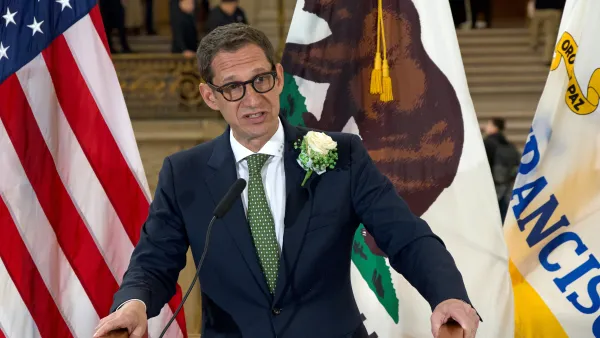
As prices skyrocket, San Francisco Mayor declares rent emergency
Landlords in San Francisco have initiated over 2,400 evictions since January, putting the city on track to see more evictions this year than during any year in the past decade.

Planetizen Federal Action Tracker
A weekly monitor of how Trump’s orders and actions are impacting planners and planning in America.

The state-sanctioned urbicide of Austin
People don’t kill cities. Freeways do.

US to reduce Colorado River water deliveries to Mexico
A new Colorado Treaty amendment reduces Mexico’s Colorado River water allocation by 250,000 acre feet.

5 New England states march closer to 800 megawatt wind energy project
Securing federal approval for the project may be complicated under the Trump administration, which has historically been hostile towards domestic wind power.

Baltimore to break ground on $50 million Transit Priority Project
The project will bring faster bus trips, safer streets and better bike connections to Baltimore.

Airbnb launches $250 million 'last-dollar financing' housing accelerator, makes first investment in Austin
The company will put $6.4 million towards affordable housing development in Texas’ capital.

FREE Course: Walkable City 1: Why Walkability?
After describing his path towards focusing on walkability as the essence of good planning, Jeff Speck marches through his five principal reasons for making more walkable places.
Reinventing Malls: Planning Alchemy—Turning Gray Fields Into Gold
The course focuses on the opportunities and imperatives that shape reinvention of mall sites.

Eagle County Government
Harvard University Graduate School of Design
Nashville Planning Department
The Architects Foundation
University of Cincinnati Online
The Pocatello Development Authority
The Urban Renewal Agency of the City of Pocatello
Journal of the American Planning Association