The suburbs are struggling right now, but they are still around, physically. Allison Arieff asks what will happen to them next?


"One unanticipated discovery that became clear from the commentary was just how deep an animosity exists between urban dwellers and suburbanites. Perhaps "saving" was the wrong verb to use in the title. True, there are many fantastic suburbs (I grew up in one) but that doesn't negate the reality of places like Rio Vista, Calif., where an upscale 855-home development called Hearth and Home at Liberty (a name so cruelly ironic it surpasses irony altogether) was abandoned last year, leaving graded streets, a few model homes and little else. Exploring what to do with the extreme - semi-abandoned, half-built subdivisions from Merced, Calif., to Lake County, Fla. - was done with the broader intention of rethinking how all communities might better be designed, built and experienced."
"This is not unexplored territory; good ideas abound, but most remain just that - great theory, little practice. Some suburbs get it right; some cities do, too. But too many, especially in recent years, just haven't."
"Housing starts were off 15.5 percent in December. Whether they return to "normal" later this year, or next year, or the year after that, it is crucial that the industry learns from its recent mistakes, which have ranged from overbuilding to product homogeneity. New (and existing) homes and communities, and the people who reside in them, whether they're on Lexington Avenue or Quail Ridge Lane, can benefit from any number of creative ideas, designs and efforts already underway not just from the "housing industry" but from your friends and neighbors, too."
Read the full story: Saving the Suburbs, Part 2
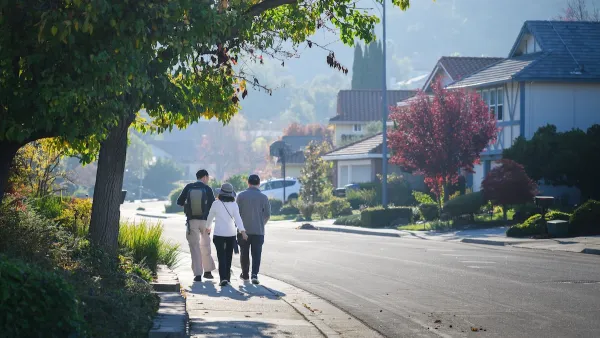
Will sprawl save California?
California residents will vote on Proposition 45 in November, which would make it easier to build large housing developments on the outskirts of the state’s cities.
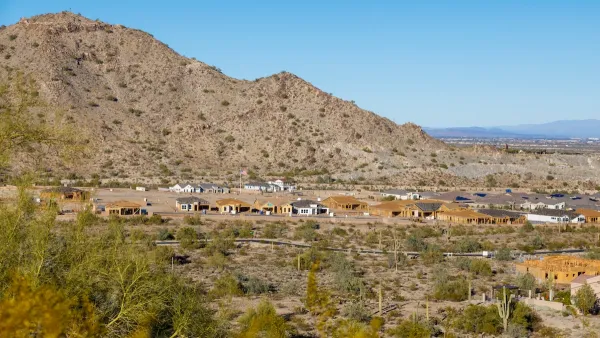
Arizona Overrides Moratorium Imposed due to Water Crisis, Approves up to 60K New Homes
A newly created legal process allows development to proceed if builders agree to bring in renewable water sources and reduce their groundwater use by 25%.
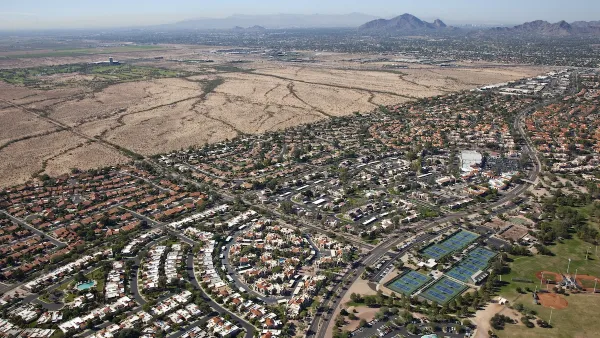
Nearly Half a Million New Arizona Homes Halted Due to Water Crisis
The Arizona Department of Water Resources has put a moratorium on new water supply permits, making the future of planned residential developments uncertain.

Planetizen Federal Action Tracker
A weekly monitor of how Trump’s orders and actions are impacting planners and planning in America.

California plans to bury El Niño’s downpour
If the state plays its cards right, it may be able to store a billion acre-feet of El Niño’s water in aquifers.

Desperate measures: Advocates weigh draining Lake Powell to fill Colorado River
Draining the reservoir could reduce evaporation losses by a couple hundred thousand acre-feet.

Mamdani’s pied-à-terre tax survives legal challenge
A panel of judges found that the plaintiffs failed to demonstrate injury as a result of New York City's implementation of the tax.

Eastern Nebraska is running out of electricity
Data centers and electrification are straining eastern Nebraska’s grid, throttling economic development.

Seattle passes record-breaking transit services expansion
Proposition 1 will double the city’s transit tax to add 95,000 more bus trips and preserve 180,000 bus trips annually.

FREE Course: Walkable City 1: Why Walkability?
After describing his path towards focusing on walkability as the essence of good planning, Jeff Speck marches through his five principal reasons for making more walkable places.
Reinventing Malls: Planning Alchemy—Turning Gray Fields Into Gold
The course focuses on the opportunities and imperatives that shape reinvention of mall sites.

City of Rosemead
Rutgers University, Edward J. Bloustein School of Planning and Public Policy
One Hundred Miles
University of Michigan School for Environment and Sustainability (SEAS)
Hunter College, City University of New York (CUNY)
The Architects Foundation
City of Cambridge
Montrose County
The Pocatello Development Authority