In industrial West Oakland, backyard farming is flourishing, with more than 80 farms sprouting up with organic produce and a local bent.


"Since the end of World War II, the west side of this city has struggled to break away from its industrial roots. Sandwiched between the city's downtown corridor and the busy Port of Oakland, West Oakland is overwrought with old railways and abandoned warehouses. Not one supermarket can be found in the eight-square-mile area, and 60% of the neighborhood's 20,000 residents live below the poverty line.
Since 2001, more than 80 urban farms have been quietly cultivated in Oakland, Calif., amid dilapidated buildings, railways and trucking depots.
Yet, amidst the snaking freeways and dilapidated buildings, a bit of green is growing. Since 2001, more than 80 urban farms have been cultivated in the backyards and vacant lots of West Oakland. Produce from zucchini to watermelon is grown for consumption by local residents; goats and chickens are raised on some farms. Last year, more than 10,000 pounds of produce was harvested, according to Oakland's City Slicker Farms, which is at the epicenter of the neighborhood's urban-farm push."
FULL STORY: A Garden Grows in Oakland

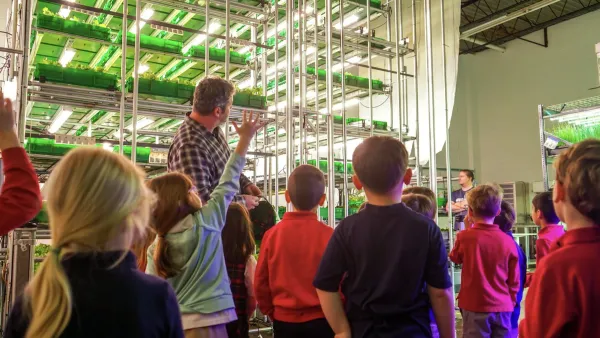
A Multimillion Dollar Virginia Company is Turning Empty Office Buildings Into Farms
Area 2 Farms envisions a world where 90% of the U.S. population lives within 10 miles of an indoor farm.
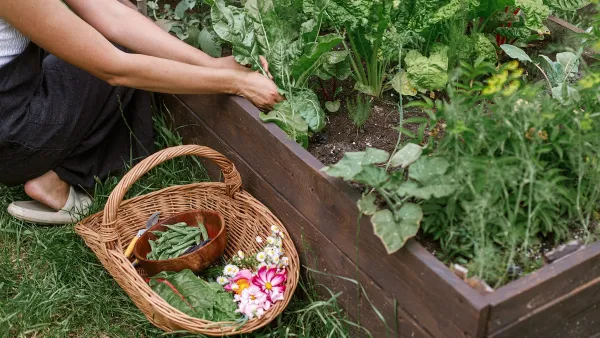
Urban Farming Addressing Hunger (and More) in Pittsburgh
Urban farming provides opportunities to increase food security in addition to other benefits.
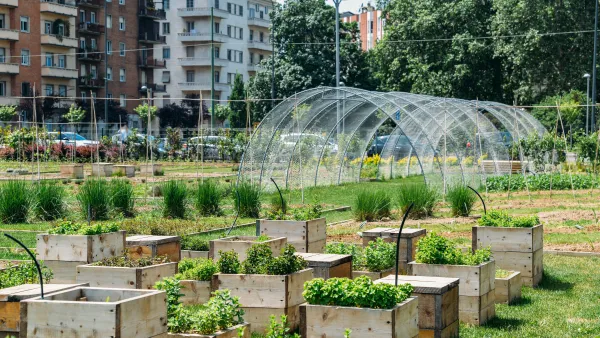
Urban Ag Activists Up In Arms About New Study
Researchers looked at the carbon footprint of urban farming versus conventional, and the results were surprising.

Planetizen Federal Action Tracker
A weekly monitor of how Trump’s orders and actions are impacting planners and planning in America.

The state-sanctioned urbicide of Austin
People don’t kill cities. Freeways do.

US to reduce Colorado River water deliveries to Mexico
A new Colorado Treaty amendment reduces Mexico’s Colorado River water allocation by 250,000 acre feet.

5 New England states march closer to 800 megawatt wind energy project
Securing federal approval for the project may be complicated under the Trump administration, which has historically been hostile towards domestic wind power.

Baltimore to break ground on $50 million Transit Priority Project
The project will bring faster bus trips, safer streets and better bike connections to Baltimore.

Airbnb launches $250 million 'last-dollar financing' housing accelerator, makes first investment in Austin
The company will put $6.4 million towards affordable housing development in Texas’ capital.

FREE Course: Walkable City 1: Why Walkability?
After describing his path towards focusing on walkability as the essence of good planning, Jeff Speck marches through his five principal reasons for making more walkable places.
Reinventing Malls: Planning Alchemy—Turning Gray Fields Into Gold
The course focuses on the opportunities and imperatives that shape reinvention of mall sites.

Eagle County Government
Harvard University Graduate School of Design
Nashville Planning Department
The Architects Foundation
University of Cincinnati Online
The Pocatello Development Authority
The Urban Renewal Agency of the City of Pocatello
Journal of the American Planning Association