The Ohio Mechanical Handling Co. reflects back on designing and building the first commercial monorail in the United States for a park in Akron, Ohio.


"The future arrived in a bright flash of silver.
Sunlight glinted on steel and aluminum as Summit Beach Park unveiled its shiny new attraction in August 1957.
A sleek monorail train glided 9 feet off the ground on a 3/4-mile track along the eastern edge of Summit Lake.
''This isn't a thrill ride,'' Summit Beach Manager Ed Palmer told the Beacon Journal. ''It's something new, something different - a ride of the future.''
The 25-cent excursion was a first and a last. It was the first commercial monorail to operate in the United States. It was also the last ride built at the Akron park."
"The monorail system featured 11-foot aluminum cars with tubular steel frames, Plexiglas roofs and foam-rubber seats. The cab, which pulled four passenger cars, had a 4-cylinder, gas-powered engine, a Ford automatic transmission and hydraulic brakes. A framework of steel beams supported the track."
Read the full story: Akron's ride of the future arrives in 1957


‘The Power of the Kraken:’ Seattle Monorail Ridership Spikes for Hockey Games
Seattle’s new professional hockey team is drawing legions of enthusiastic fans. Around a quarter of them are taking public transit, such as the city’s often-maligned monorail, to games.
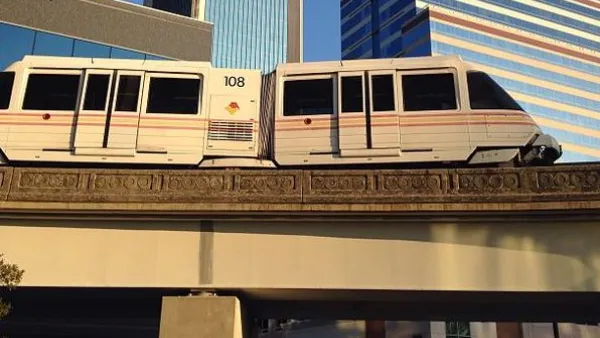
Jacksonville To Replace Monorail With Autonomous Shuttles
The city’s aging monorail system will be repurposed as part of an expanded 10-mile shuttle system.
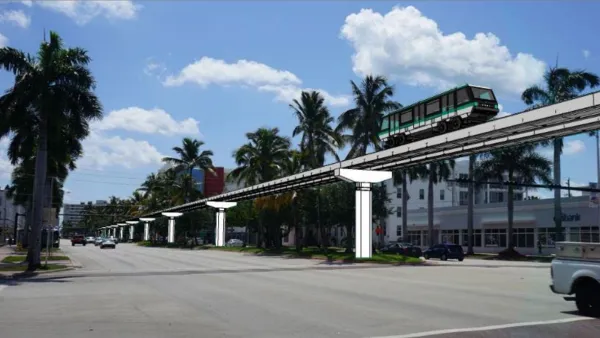
Miami Rapid Transit Project Moves Forward
The county completed the draft environmental impact study for a monorail and people mover planned as part of its rapid transit system.

Planetizen Federal Action Tracker
A weekly monitor of how Trump’s orders and actions are impacting planners and planning in America.

Amtrak, CN end decades-long dispute with eight-year agreement
The new operating agreement establishes an updated framework for the companies to work together, including processes to resolve disputes.

Judges permit Denver to divert 77,000 acre feet from the Colorado River for reservoir expansion
Overuse and climate change have caused the Colorado River’s water levels to plummet.

Northwest rail fans eager for Sept. 30 debut of Amtrak’s Airo fleet
Get ready for that new train smell and more seats. But they won’t go faster or run more frequently on the Cascades route in Washington and Oregon.

NYC DOT wants faster, more permanent street upgrades
The city is examining ways to build more concrete infrastructure without getting entangled in 'decades-long' projects.

'Something we’ve never seen before:' rising utility rates could strain city finances nationwide
Data centers, climate change and other factors have caused utility rates in the United States to increase by 38% since 2020.

FREE Course: Walkable City 1: Why Walkability?
After describing his path towards focusing on walkability as the essence of good planning, Jeff Speck marches through his five principal reasons for making more walkable places.
Reinventing Malls: Planning Alchemy—Turning Gray Fields Into Gold
The course focuses on the opportunities and imperatives that shape reinvention of mall sites.

Harvard University Graduate School of Design
KFH Group Inc.
Greater Baltimore Committee
The Architects Foundation
University of Cincinnati Online
The Pocatello Development Authority
The Urban Renewal Agency of the City of Pocatello