Officials in Los Angeles have renamed the former "South Central" to remove the stigma of riots in the 1990's. But some business owners and residents say that's had a greater negative consequence than keeping the old name would have.


"Five years ago, the city expunged the name 'South Central' from its maps and replaced it with the more general 'South Los Angeles.' The change was meant to erase the stigma of riots and blight that marred an area south of the 10 Freeway and along Central Avenue, a place renowned in the 1940s for its thriving black culture -- restaurants, jazz clubs and businesses.
But an unintended consequence was to make core neighborhoods around Central Avenue disappear from Angelenos' mental map -- arguably none so much as Newton, a patch of nowhere east of the Harbor Freeway.
'Namelessness matters,' said Josh Sides, professor of California history at Cal State Northridge. 'A nameless place doesn't exist. . . . Speculators, developers, want to invest in a place that exists.'
Government workers say it is more difficult to organize people who aren't unified by a geographic name. Advocates say lack of identity makes it more difficult to attract resources and develop services. A developer said it's one reason this area is a kind of last frontier for new construction."
Read the full story: Without a name, former 'South Central' L.A. has become almost invisible


California’s Brightline West High-Speed Rail Announces 2029 Completion Date
The Las Vegas-to-Southern California rail line was originally slated to open for service in time for the 2028 Olympics.
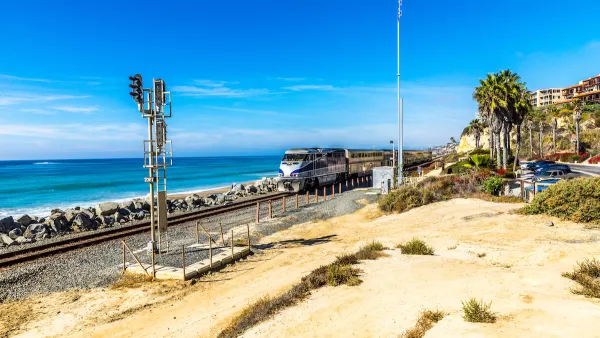
Storms Sever California Rail Line—Again
The coast-hugging rail corridor linking Los Angeles and San Diego faces an uncertain future as mudslides once again force part of the line to close.
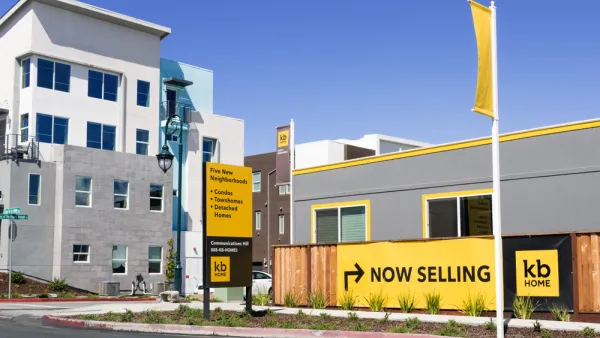
Los Angeles' Merchant of Sprawl
Los Angeles is mourning the death of billionaire philanthropist Eli Broad. For all of Broad's many civic contributions, he made his fortune in a decidedly anti-urban way.

Planetizen Federal Action Tracker
A weekly monitor of how Trump’s orders and actions are impacting planners and planning in America.

‘Going backwards:’ Baltimore mayor, students rally against state's transit funding plan
Maryland's proposed six-year plan provides no funding for Baltimore’s BMORE bus program and reduces its road maintenance funding.
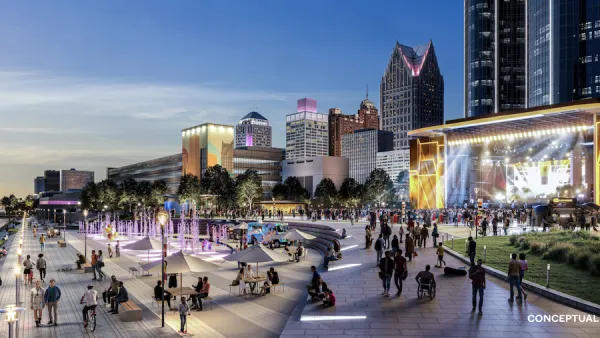
Detroit to transform waterfront with $2.2 billion investment
Developers will convert about 18 acres of unused parking lot space into civic spaces.

Data center developers are using lawsuits, cash offers to ‘overwhelm’ rural America
Newsrooms in five states worked together to uncover the tactics big tech developers use to buy land from reluctant communities.

U.S.-Iran war may have ‘devastating’ impact on cost to warm homes
Vermont and Maine residents may see a 76% increase in the cost of warming their homes this winter.

Senate bill would ‘overhaul’ environmental permitting laws
Under the proposed act, government agencies would also not be able to suspend or rescind permits after granting them.

FREE Course: Walkable City 1: Why Walkability?
After describing his path towards focusing on walkability as the essence of good planning, Jeff Speck marches through his five principal reasons for making more walkable places.
Reinventing Malls: Planning Alchemy—Turning Gray Fields Into Gold
The course focuses on the opportunities and imperatives that shape reinvention of mall sites.

One Hundred Miles
County of Mendocino
planning NEXT
The Architects Foundation
University of Cincinnati Online
Montrose County
Northern Illinois Transit Authority (NITA)
The Pocatello Development Authority