A grassroots group is working to remove barriers to erecting clotheslines, which are commonly banned by apartments buildings as a blight. The group is pitching their work as an energy conservation effort.


"One dryer, Alex Lee knows today, eats up to $100 or more in power each year while emitting up to a ton of carbon dioxide. Collectively, America's more than 80 million dryers annually burn 6 to 10 percent of all residential electricity - second only to refrigerators and the equivalent of 30 million tons of coal or the output of the nation's 15 least productive nuclear reactors.
Lee, 33, sees clotheslines as the solution. But a growing number of housing complexes and communities, viewing them as eyesores that lower property values, have gone so far as to ban them.
Aiming to change attitudes and laws, Lee founded Project Laundry List. What began as a college campaign to promote clotheslines has grown into an internationally known nonprofit organization 'to educate people,' according to its mission statement, 'about how simple lifestyle modifications, including air-drying one's clothes, reduce our dependence on environmentally and culturally costly energy sources.'"
Read the full story: Airing his laundry

New England Clothesline Measures Up In Air
Measures are moving forward in Connecticut and Vermont that would protect the rights of residents to dry their laundry on clotheslines -- an act many opponents say drives down property values.
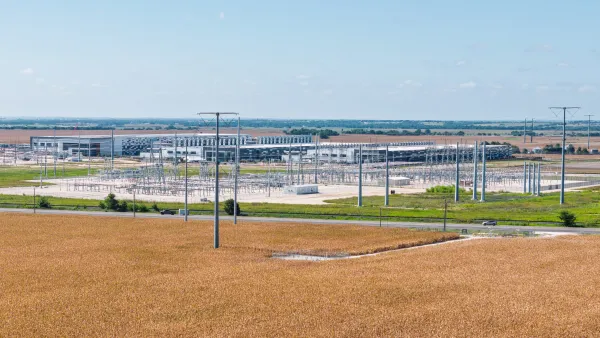
As Texans face soaring electricity costs, a public health crisis looms
Demand for electricity in Texas is surging, largely driven by data centers and other industries, and residential customers are footing the bill.
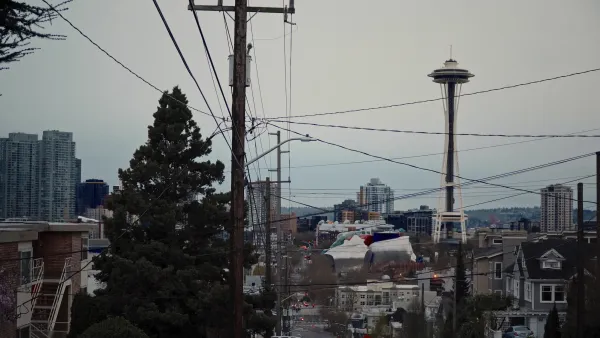
Seattle Density Increase Stymied by Underground Power Line Requirement
A new policy that requires buildings with four or more units to bury their electrical lines is making housing development more costly and causing months-long delays.

Planetizen Federal Action Tracker
A weekly monitor of how Trump’s orders and actions are impacting planners and planning in America.

Amtrak, CN end decades-long dispute with eight-year agreement
The new operating agreement establishes an updated framework for the companies to work together, including processes to resolve disputes.

Judges permit Denver to divert 77,000 acre feet from the Colorado River for reservoir expansion
Overuse and climate change have caused the Colorado River’s water levels to plummet.

Atlanta City Council unanimously backs $3.5 billion Beltline light rail project
The resolution was drafted after Atlanta Mayor Andre Dickens pulled support for the Atlanta Streetcar extension last year.

SEPTA to bring nearby frequent transit to over 1 million new riders as part of decade-long plan
The agency's Accelerate plan will also bring frequent transit to twice the amount of jobs that are currently located near it.

NYC plants over 18,000 trees, the most new foliage in a decade
Many of the trees were planted in communities vulnerable to extreme heat.

FREE Course: Walkable City 1: Why Walkability?
After describing his path towards focusing on walkability as the essence of good planning, Jeff Speck marches through his five principal reasons for making more walkable places.
Reinventing Malls: Planning Alchemy—Turning Gray Fields Into Gold
The course focuses on the opportunities and imperatives that shape reinvention of mall sites.

City of Thousand Oaks
City of Wisconsin Rapids
Harvard University Graduate School of Design
The Architects Foundation
University of Cincinnati Online
The Pocatello Development Authority
The Urban Renewal Agency of the City of Pocatello