City commits to adding over 450 miles of new bikeways/lanes linking neighborhoods, parks, downtown, and employment centers over the next 20 years and making an initial investment of $20 million.


"Columbus Mayor Michael B. Coleman issued the draft of the Bicentennial Bikeways Plan calling for a major $170 million investment in biking facilities over the next 20 years, including an immediate $20 million commitment towards the first phase. The plan calls for an integrated 500-plus-mile system to serve the entire city and providing linkages to the regional bikeway system, including the 3-C trail that crosses the entire state from Cincinnati to Cleveland via Columbus. The plan was announced on May 12th during Bike to Work week with over 100 cyclists joining the mayor, who biked from home, in front of the Ohio Statehouse. With 87 miles of routes and trails currently, the city expects to add by 2012 an additional 31 miles of off-street trails, 58 miles of on-street bike lanes, and installing hundreds of bike racks and other amenities. The city hired Alta Planning and Design as project consultant."
Thanks to Vince Papsidero, AICP
Read the full story: City Has Big Plans for Bikes
Creating a Network of Bikeways
Mike Lydon discusses the importance of creating "bikeway networks" -- systems of bike lanes and infrastructures that have varied forms for varied situations.
On Bicyclists
There are three types of bicyclists: Advanced Bicyclists, Intermediate Bicyclists and Beginner Bicyclists. We need to plan and build facilities to accommodate all of them. Those cities that do are experiencing ridership numbers far above the national average.
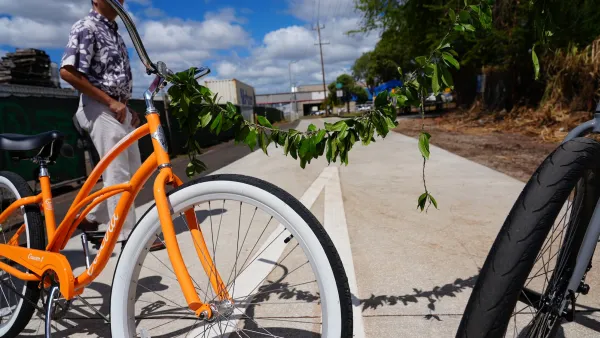
Hawaii’s Pearl Harbor Bike Path is Flooding More Often, Forcing Commuters Onto More Dangerous Roads
The 5-mile trail serves as a key bikeway for commuters connecting to local transit.

Planetizen Federal Action Tracker
A weekly monitor of how Trump’s orders and actions are impacting planners and planning in America.

Eastern Nebraska is running out of electricity
Data centers and electrification are straining eastern Nebraska’s grid, throttling economic development.

Study reveals best places in the U.S. for cycling, walking
New research from Streetlight Data examines bicycle and pedestrian miles per capita in the 100 largest U.S. cities by population.

DSA members accuse Mamdani of 'abandoning values' over housing redevelopment
New York City's mayor plans to replace about 2,000 units of public housing with private, mixed-income housing.

All sides of BRT debate unhappy with CDOT’s most recent move
The Colorado Department of Transportation is no longer considering center-running bus lanes for Colorado Boulevard.

Massachusetts bogs generate both power, and cranberries
Putting solar panels above farmland is one way Massachusetts is advancing toward its goal of net-zero carbon emissions by 2050.

FREE Course: Walkable City 1: Why Walkability?
After describing his path towards focusing on walkability as the essence of good planning, Jeff Speck marches through his five principal reasons for making more walkable places.
Reinventing Malls: Planning Alchemy—Turning Gray Fields Into Gold
The course focuses on the opportunities and imperatives that shape reinvention of mall sites.

City of Rosemead
Rutgers University, Edward J. Bloustein School of Planning and Public Policy
One Hundred Miles
University of Michigan School for Environment and Sustainability (SEAS)
Hunter College, City University of New York (CUNY)
The Architects Foundation
City of Cambridge
The Pocatello Development Authority
The Urban Renewal Agency of the City of Pocatello