$153 million in congestion reduction funds that had been awarded to New York City will now go to Chicago to apply congestion pricing to street parking spaces. Funds will also go toward developing pilot Bus Rapid Transit routes on dedicated lanes.


"The use of congestion pricing for the city's metered parking spaces is key to Chicago's bold and ambitious plan, U.S. Secretary of Transportation Peters emphasized. Higher street meter rates during the morning and evening rush periods will encourage commuters to take transit downtown instead of driving. And, the new Bus Rapid Transit (BRT) routes will be available for those who don't want to pay more for parking.
The federal funding is contingent, in part, on the city and the Chicago Transit Authority (CTA) adopting the necessary legal authorities. Also, the city must successfully move forward on its previously announced plans to privatize its metered parking system and enter into a long-term agreement with a private firm by December 31, 2008."
"The new (as yet, unidentified) BRT routes will have their own dedicated lanes and the buses will be equipped with technology to help speed them through traffic with priority right of way at busy signalized intersections. In addition, the CTA will be able to purchase new and cleaner hybrid engine vehicles, Peters said."
From Chicago Tribune:
"Another component of the plan involves creating fees for on-street truck-loading zones downtown."
"On the bus rapid-transit routes, the CTA will operate articulated, hybrid buses to reduce pollution. These buses are on order, officials said."
"The mayor said the meter parking program and the express buses will complement each other, adding that he hopes Chicago eventually will have 100 miles of bus express lanes.
Peters said Los Angeles currently is testing express-lane buses, but Chicago will be the first major city to deploy such routes on a large scale.
Some of the federal money awarded to Chicago includes funds that New York City relinquished after it abandoned plans to test congestion pricing for drivers entering Manhattan."
Read the full story: U.S. Secretary of Transportation Selects Chicago to Receive More Than $153 million in Federal Funding to Reduce Traffic Congestion (04/29/08)
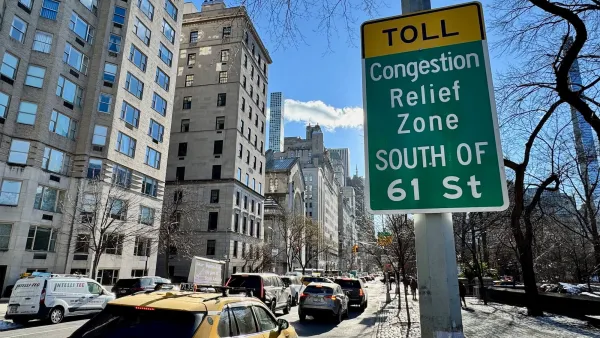
Study: NYC congestion pricing didn't impact parking demand
A city report shows that free parking, not congestion pricing, is the main driver of limited parking demand in the city.
The Urbanist Case Against Congestion Pricing
And why it is wrong.
A Market Urbanism Manifesto
In his new book on market urbanism, Scott Beyer describes market urbanism and to compares it to the status quo.

Desperate measures: Advocates weigh draining Lake Powell to fill Colorado River
Draining the reservoir could reduce evaporation losses by a couple hundred thousand acre-feet.

Eastern Nebraska is running out of electricity
Data centers and electrification are straining eastern Nebraska’s grid, throttling economic development.

Malls are becoming the midtowns of the future
Mall and office park redevelopments are a generational opportunity to create new nodes of urbanity.

NYC breaks ground on anti-flooding infrastructure project
New York City's new system will reduce stormwater flows to local sewers by 90%.

One Kentucky town’s secret to affordable housing
The Smoketown Community Land Trust has already built seven affordable homes for community members.

Houston gains petal-shaped cooling infrastructure to make streets more ‘delightful’
The city has installed the pavilions along 15 blocks in Houston.

FREE Course: Walkable City 1: Why Walkability?
After describing his path towards focusing on walkability as the essence of good planning, Jeff Speck marches through his five principal reasons for making more walkable places.
Reinventing Malls: Planning Alchemy—Turning Gray Fields Into Gold
The course focuses on the opportunities and imperatives that shape reinvention of mall sites.

City of Rosemead
Rutgers University, Edward J. Bloustein School of Planning and Public Policy
One Hundred Miles
University of Michigan School for Environment and Sustainability (SEAS)
Hunter College, City University of New York (CUNY)
The Architects Foundation
City of Cambridge
Montrose County
The Pocatello Development Authority