Seattle's new light rail line is poised to usher in a new era for Martin Luther King Jr. Way. Though most are excited about the new development, the fear of gentrification has made some residents worry that they won't be around to reap the benefits.


"When Sound Transit decided to run the region's first light-rail line down MLK a decade ago, backers predicted it would spark a redevelopment boom in one of Seattle's poorest, most neglected, most ethnically diverse corridors.
Now, at last, that prediction is starting to come true.
Over the past year private, for-profit developers have proposed more than 1,500 condo and apartment units within a 10-minute walk of a rail station. They will be the Rainier Valley's first multifamily projects built without government subsidies in more than 30 years, city officials say."
"But the specter of gentrification looms. MLK is a cornucopia of diversity - Chinese herb shops, Vietnamese video stores, Somali money-transfer offices, Filipino meat markets and restaurants that serve everything from soul food and tortas to goat curry and pho.
Smith and others say rising rents and real-estate prices already are forcing out some businesses and residents and threatening to dilute this rich ethnic stew.
Government officials, community organizations - and developers - all say they want to prevent that, to make sure the valley's renaissance benefits those who are already here."
Read the full story: New light rail clears way for an MLK makeover
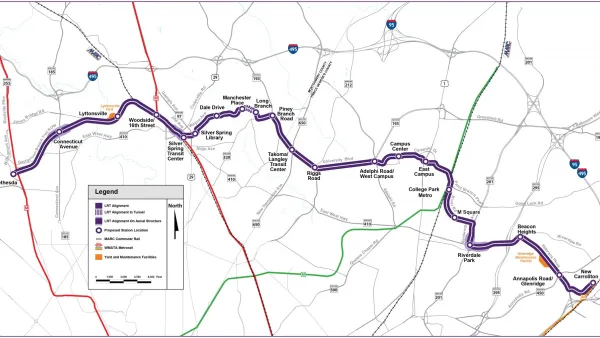
Coalition Fights Displacement Along Purple Line
Community advocates are warning that Maryland’s new light rail line could cause displacement without concerted efforts to preserve affordable housing and legacy businesses.
L.A.'s Complicated Dance Between TOD and Displacement
As the Los Angeles metro area expands its transit options, transit-oriented development is following suit. In some neighborhoods, lower-income residents are being displaced.
Development Near Dallas Light Rail has ‘Directly Created’ Over 5,000 Jobs, Generated $18 Billion Over 25 Years
Transit-oriented development has spurred billions in economic activity along DART light rail.

Planetizen Federal Action Tracker
A weekly monitor of how Trump’s orders and actions are impacting planners and planning in America.

Washington state to charge fee to drivers with fuel-efficient cars
Revenue from the fee will go towards supporting the state’s highways.

Trump to blast ‘hydrocarbon highway’ through ‘world’s longest art gallery’
Environmental and historic preservation groups are suing to stop the project.

Data centers need power – lower income, rural residents pay the price
In 2025, data centers paid only 38% of the energy infrastructure costs linked to their growth, with households, especially rural and low-income residents, bearing the remaining burden.

MBTA Green Line project moved to next phrase of CIG program
The modernization effort will cost $4.08 billion.

22-mile pedestrian and bike path to encircle Atlanta by 2030
The project will also support affordable housing.

FREE Course: Walkable City 1: Why Walkability?
After describing his path towards focusing on walkability as the essence of good planning, Jeff Speck marches through his five principal reasons for making more walkable places.
Reinventing Malls: Planning Alchemy—Turning Gray Fields Into Gold
The course focuses on the opportunities and imperatives that shape reinvention of mall sites.

City of Charlotte
City of Rosemead
Rutgers University, Edward J. Bloustein School of Planning and Public Policy
University of Michigan School for Environment and Sustainability (SEAS)
Hunter College, City University of New York (CUNY)
The Architects Foundation
University District Partnership