Lakewood plans to close some schools and consolidate students to a centralized early education center, eliminating years of work that created safe walking routes to neighborhood schools.


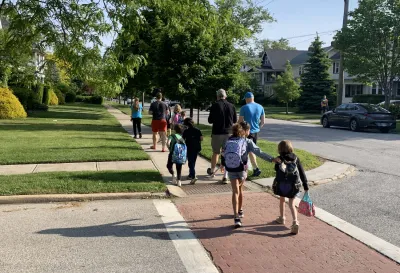
School board officials in Lakewood, Ohio voted to convert an elementary school into a centralized early education center on the grounds that the school was operating at a reduced capacity. However, the change would force students to travel to the school from farther away, “effectively sacrificing” the district’s reputation for walkability.
As Kea Wilson explains in Streetsblog USA, the “small but seismic change” would mean that the district would close some small neighborhood schools on safe routes to direct students elsewhere.
That “system of social infrastructure,” many Lakewood families argue, is at least partly an outgrowth of the city's history as a streetcar suburb, which left the community with a compact, walkable grid and minimal school parking lots, even after the streetcars stopped running, as well as decades of conscientious district planning that allowed Lakewood to maintain small neighborhoods schools even as family sizes and student enrollment shrunk nationwide.
More importantly, “For families without cars, though, losing access to a walkable school may mean losing access to school, period — a major issue in a district that already struggles with absenteeism.”
According to an analysis from the Natural Resources Defense Council, 23 percent of residents of Ohio’s 11th district belong to households with no cars. “The burden of the decision, of course, will have the most impact on the families within Lincoln's immediate footprint, but parents of multiple children say those challenges will be steep for them, too — especially if one kid is young enough to be shunted to the district's single early learning center while the older one walks to the school around the corner, both at exactly the same drop-off time.”
For Seth Kaplan, author of “Fragile Neighborhoods: Repairing American Society One ZIP Code at a Time,” walkable neighborhood systems based in part around schools “aren't fungible educational facilities. They're irreplaceable community anchors.”


When ‘Prioritizing All Modes’ Is a Lie
In many cases, it’s impossible to prioritize the safety of pedestrians and other vulnerable road users without sacrificing some speed.
Opinion: Road Safety Data Should Include Close Calls
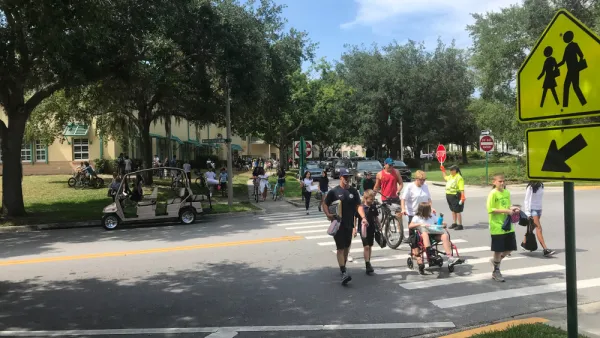
Even in the absence of lethal collisions, the experience of repeated near-misses can discourage pedestrians from walking and degrade public perception of road safety.
Study: Midblock pedestrian crossings are more common than we think
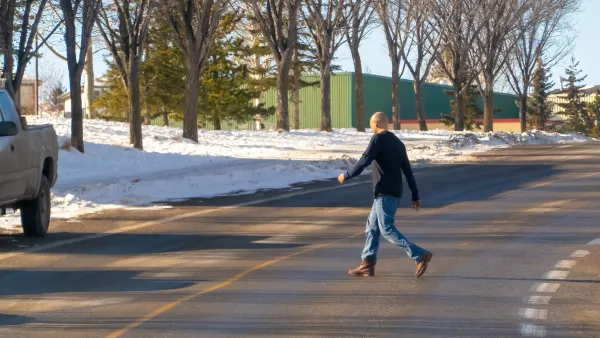
One in six crossings in the study took place outside of a marked crosswalk.

Planetizen Federal Action Tracker
A weekly monitor of how Trump’s orders and actions are impacting planners and planning in America.

The state-sanctioned urbicide of Austin
People don’t kill cities. Freeways do.

US to reduce Colorado River water deliveries to Mexico
A new Colorado Treaty amendment reduces Mexico’s Colorado River water allocation by 250,000 acre feet.

Mamdani overhauls NYC's Vision Zero plan with 100 new policy goals
The overhaul aims to reduce traffic deaths and make streets safer for pedestrians, cyclists and drivers through lower speed limits, new safety infrastructure and more.

Amtrak not solely to blame for New Jersey commuter rail's unreliability, report finds
A new study from the Garden State Initiative found that NJ Transit’s budget grew 20% across a 4 year period, but reliability declined significantly over the same period.

EPA erases limits on planet-warming pollution from power plants
Under Monday’s plan, power plants would still have some limits on how much mercury, arsenic and other contaminants they can emit.

FREE Course: Walkable City 1: Why Walkability?
After describing his path towards focusing on walkability as the essence of good planning, Jeff Speck marches through his five principal reasons for making more walkable places.
Reinventing Malls: Planning Alchemy—Turning Gray Fields Into Gold
The course focuses on the opportunities and imperatives that shape reinvention of mall sites.

Eagle County Government
Harvard University Graduate School of Design
Nashville Planning Department
The Architects Foundation
University of Cincinnati Online
The Pocatello Development Authority
The Urban Renewal Agency of the City of Pocatello
Journal of the American Planning Association