C-MORE grants were earmarked for industry trade groups and universities.



Nearly two dozen projects related to measuring and reducing carbon emissions in construction materials have been terminated by the EPA. The grants, issued through the C-MORE program (Construction Material Opportunities to Reduce Emissions) were issued for economic purposes. The goal was to support US construction products to be more competitive both domestically and in international markets that have more stringent emissions requirements.
Reporting on the cuts, Inside Climate News lists the 21 projects whose grants were terminated. Among universities and research projects, many of the grants were earmarked for trade organizations like the National Asphalt Pavement Association, the Portland Cement Association, the National Ready Mixed Concrete Association and others. The list of cuts was provided by the EPA to the Sierra Club through a public records request.
The Inside Climate News article quotes Max Puchtel from the American Institute of Steel Construction, one of 19 trade groups that sent a letter to the EPA in February urging them to maintain the grants.
“This program will drive innovation by funding projects that improve energy efficiency, giving U.S. manufacturers a competitive edge in key industries like automotive, steel, concrete, aluminum, chemicals, and construction,” the letter said. “It will lower long-term costs, boost profitability, and strengthen domestic supply chains, making U.S. companies more resilient and less reliant on foreign suppliers. Ultimately, it will enhance energy independence, secure jobs, and create new opportunities.”
Read Inside Climate News’ full report below.
FULL STORY: EPA Decimates Grant Program Aimed at Measuring and Reducing Construction Material Emissions


Affordable Housing Renovations Halt Mid-Air Amidst DOGE Clawbacks
HUD may rescind over a billion dollars earmarked for green building upgrades.
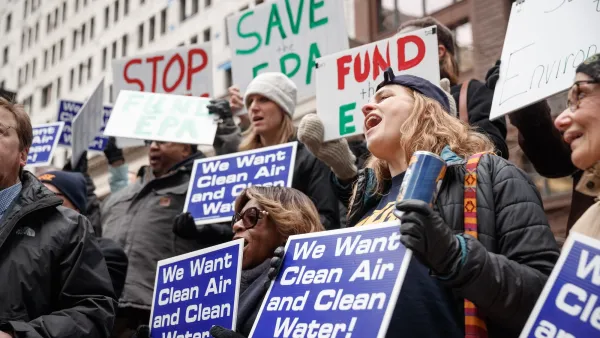
EPA Guts Emissions Regulations
The agency is eliminating the endangerment finding that underpins the agency’s authority to regulate greenhouse gas emissions.
EPA Plans “Largest Deregulatory Action” in History
The agency plans to repeal a key 2009 rule that underpins the government’s authority to regulate greenhouse gas emissions.

Planetizen Federal Action Tracker
A weekly monitor of how Trump’s orders and actions are impacting planners and planning in America.

The state-sanctioned urbicide of Austin
People don’t kill cities. Freeways do.

US to reduce Colorado River water deliveries to Mexico
A new Colorado Treaty amendment reduces Mexico’s Colorado River water allocation by 250,000 acre feet.

5 New England states march closer to 800 megawatt wind energy project
Securing federal approval for the project may be complicated under the Trump administration, which has historically been hostile towards domestic wind power.

Baltimore to break ground on $50 million Transit Priority Project
The project will bring faster bus trips, safer streets and better bike connections to Baltimore.

Airbnb launches $250 million 'last-dollar financing' housing accelerator, makes first investment in Austin
The company will put $6.4 million towards affordable housing development in Texas’ capital.

FREE Course: Walkable City 1: Why Walkability?
After describing his path towards focusing on walkability as the essence of good planning, Jeff Speck marches through his five principal reasons for making more walkable places.
Reinventing Malls: Planning Alchemy—Turning Gray Fields Into Gold
The course focuses on the opportunities and imperatives that shape reinvention of mall sites.

Eagle County Government
Harvard University Graduate School of Design
Nashville Planning Department
The Architects Foundation
University of Cincinnati Online
The Pocatello Development Authority
The Urban Renewal Agency of the City of Pocatello
Journal of the American Planning Association