When it comes to solving traffic problems, the current federal administration is on track for failure, waste, and hypocrisy.


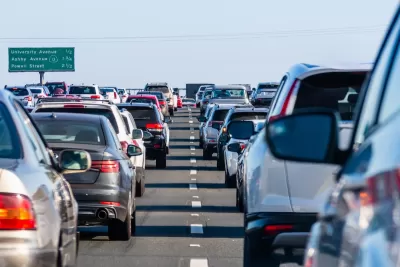
A century of experience shows that cities cannot build enough road capacity to reduce traffic congestion; there are simply too many potential trips. Researchers find that within a year or two, induced vehicle travel fills the added capacity, so congestion returns to its previous intensity with larger traffic volumes which increases external costs including downstream congestion (for example, expanding an urban highway increases surface street traffic and parking problems), crash risk, pollution and sprawl-related costs.
Transportation agencies face the roadway expansion paradox: motorists want additional road capacity provided somebody else bears the costs but are unwilling to pay the added capacity through tolls. As a result, such projects are economically inefficient – their costs generally exceed their benefits.
Effective congestion relief requires a combination of improvements to space-efficient modes – walking, bicycling, ridesharing, public transit and telework – plus TDM incentives for travellers to use those modes rather than drive when possible. These incentives can include dedicated lanes, so bikes and high occupant vehicles can avoid congestion delays; variable tolls and parking fees that have higher rates during peak periods and lower-rates at less congested times and locations; plus commute trip reduction, school transport management and mobility management marketing programs that provide targetted information and incentives. Since walking is an important mode for local trips and provides access to public transit and parking facilities, pedestrian improvements play an important but often overlooked role.
When motorists say that they don’t want decongestion tolls they are really saying that they want congestion, because no other solution is effective.
I can understand why motorists are skeptical of new road tolls; consumers generally oppose paying for something that they previously received for free (excepting bottled water – for some reason many people are perfectly happy paying a dollar for a pint of water that is virtually free from the tap), but unpriced roads are not really free, the choice is really between paying with money or with time – paying with money is actually far better because it allows higher-value trips to outbid lower-value trips for scarce urban road space, increasing system efficiency, and it generates revenues that can fund public services. As a result, most experts support efficient road pricing.
Here's the irony: for decades conservative organizations including the Reason Foundation, the Heritage Foundation and the Cato Institute supported decongestion pricing, and the USDOT’s recent policy memo claims to prioritize projects that utilize user-payer models such as toll roads, yet Trump is now trying to end New York City’s first-in-the-US decongestion toll, and conservatives have fallen in line. They now oppose this once-in-a-generation opportunity to solve urban congestion.
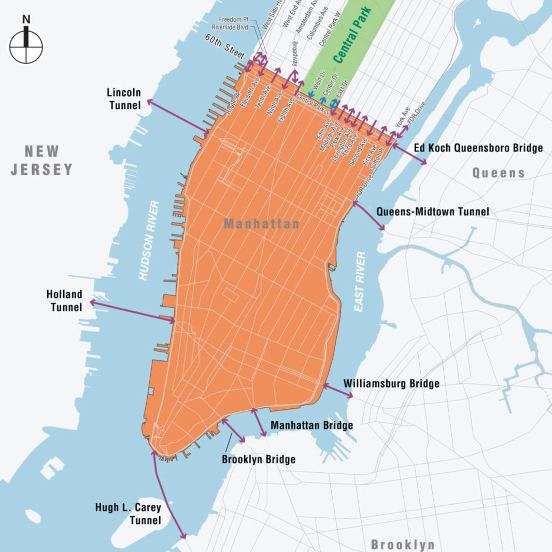
Preliminary results show that the Manhattan toll program is successful: it is reducing total vehicle traffic, resulting in faster commutes, fewer crashes and less traffic noise. Vehicle trips to the tolled area declined 7.5% compared with the previous year causing rush hour trips to take 30% less time into lower Manhattan, and about 50% less time across 34th Street — a major thoroughfare.
Despite fewer vehicle trips about 5% more people are visiting lower Manhattan and Broadway show attendance rose 17%. Note to businesses: people have wallets, not cars, so commerce increases if more people can travel at lower costs or if your neighborhood becomes more livable. The program has proven popular among affected people: two thirds of travellers who frequently drive to lower Manhattan support congestion pricing.
“The impact of the congestion relief zone in the city has been immediate and positive,” Kathryn Wylde, the CEO of the Partnership for New York City, a business advocacy group, said in a statement. “Congestion pricing is a market driven, user fee that allows people who opt to drive into the city to gain immediate benefits.”
Conservative organizations raise absurd objections to New York's tolls. The Reason and Heritage foundations consider the fees too low for taxis and too high for disabled motorists, and claim that they are unfair to motorists who receive no benefits. Those arguments are silly. If their real objection is the price structure, they should advocate for changes. The number of disabled people who drive weekdays to lower Manhattan is tiny compared with the number who benefit from reduced vehicle traffic and improved public transit. Their claim that motorists don't benefit is simply wrong; drivers benefit directly from tolls when they would rather save time than money, and indirectly because public transit service improvements reduce their traffic and parking congestion and chauffeuring burdens. Public transit service quality determines vehicle travel's price elasticity: if transit is inconvenient, uncomfortable or expensive a higher road toll is required to convince travelers to shift mode, so transit service improvements can save toll payers money.
The real reason that Trump and his conservative followers suddenly oppose New York tolls is that pricing is effective at reducing traffic problems including congestion, crashes and pollution; since many rational liberals support it those conservatives now oppose it.
Conservatives, please start being rational. You claim to support market solutions, government efficiency and fairness; it’s time to apply your principles.

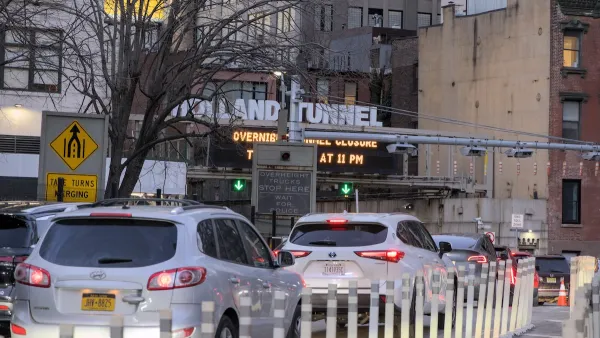
NYC Congestion Pricing Continues to Show Positive Results
While the Trump administration attempts to revoke the program’s federal approval, congestion pricing continues to reduce traffic, speed up bus travel times, and improve air quality in Manhattan.
Agreement Keeps NYC Congestion Pricing Alive Through Summer
The tolling program will continue while a court considers the city’s lawsuit against the Trump administration.
Beyond Congestion Pricing: Strategies for Revolutionizing Urban Mobility
How cities are leveraging data and technology to improve their transportation networks and reduce traffic.

Planetizen Federal Action Tracker
A weekly monitor of how Trump’s orders and actions are impacting planners and planning in America.

Amtrak, CN end decades-long dispute with eight-year agreement
The new operating agreement establishes an updated framework for the companies to work together, including processes to resolve disputes.

Northwest rail fans eager for Sept. 30 debut of Amtrak’s Airo fleet
Get ready for that new train smell and more seats. But they won’t go faster or run more frequently on the Cascades route in Washington and Oregon.

LAX SkyLink opening delayed again, contractor won’t commit to new deadline
The project was supposed to open its doors to the public in 2023.

Caltrain may slash over one-third of its stations
If Bay Area voters reject two transit tax measures, Caltrain, BART and AC Transit will see steep service cuts.

A 'dangerous' precedent: North Carolina successfully pressures communities into voting for toll roads
Two mayors resigned from the Charlotte Regional Transportation Planning Organization after it voted in favor of the toll roads.

FREE Course: Walkable City 1: Why Walkability?
After describing his path towards focusing on walkability as the essence of good planning, Jeff Speck marches through his five principal reasons for making more walkable places.
Reinventing Malls: Planning Alchemy—Turning Gray Fields Into Gold
The course focuses on the opportunities and imperatives that shape reinvention of mall sites.

City of Thousand Oaks
City of Wisconsin Rapids
Harvard University Graduate School of Design
The Architects Foundation
University of Cincinnati Online
The Pocatello Development Authority
The Urban Renewal Agency of the City of Pocatello

