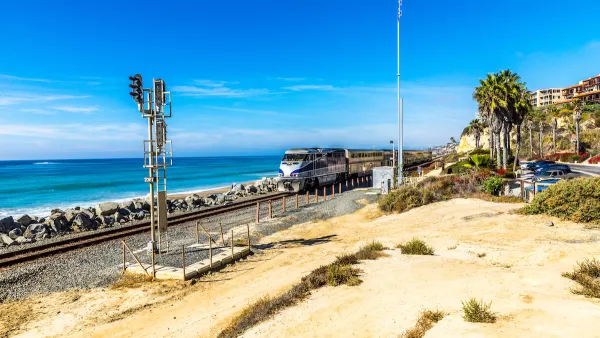
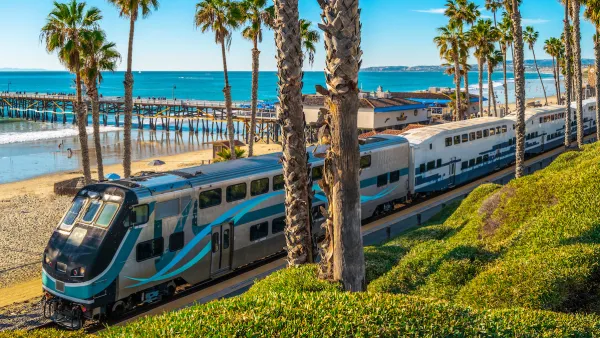
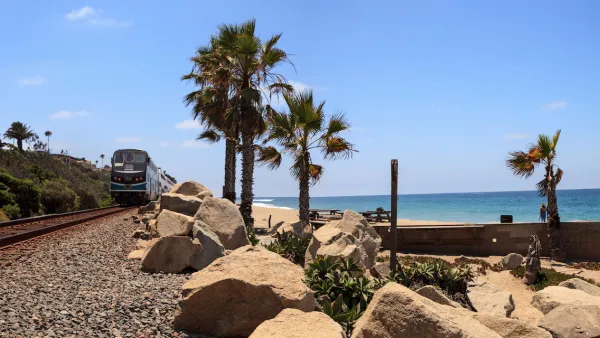
Train tracks running along the Pacific Ocean are in danger from sea level rise, but residents are divided on how to fix the problem.


A rail line in Southern California is growing increasingly unstable due to coastal erosion, but local residents and officials are in disagreement over how and where to relocate it.
Last week, the San Diego Association of Governments voted to narrow down the proposed plans to four options, “But a final decision remains far off.”
After SANDAG presented three potential options for relocating the track, “Del Mar residents raised concerns about tunnel construction and operations beneath their homes, citing risks from vibration and pollution.” One route was opposed by environmentalists because it cut through a lagoon. Another, which would have tunneled under the San Diego County Fairgrounds, also faced opposition.
“In light of all that, the agency re-examined the issue, ultimately leading to the vote on Friday. Three of the options now on the table would move the line off the bluffs; a fourth would keep the track where it is, reinforce the bluffs and add a second track next to the existing one.” Meanwhile, emergency repairs offer only a short-term solution for the problem as local officials continue to debate their options.
FULL STORY: A Scenic California Rail Line Sits on an Eroding Cliff. Where Should the Tracks Go?

Storms Sever California Rail Line—Again
The coast-hugging rail corridor linking Los Angeles and San Diego faces an uncertain future as mudslides once again force part of the line to close.
Southern California Rail Corridor In Danger From Erosion, Lack of Leadership
With a patchwork of management and local agencies involved, the imperiled rail corridor has no unified plan for improving or relocating tracks impacted by coastal erosion.
State Leaders Warn of Risks to Southern California Rail Corridor
Coastal erosion and rising sea levels threaten one of the nation’s most scenic—and strategically important—rail corridors.

The state-sanctioned urbicide of Austin
People don’t kill cities. Freeways do.

US to reduce Colorado River water deliveries to Mexico
A new Colorado Treaty amendment reduces Mexico’s Colorado River water allocation by 250,000 acre feet.

New Jersey’s second-largest city bans standalone data centers
Jersey City will continue to allow co-location facilities, such as those meant for research institutions that store their own data.

Amtrak not solely to blame for New Jersey commuter rail's unreliability, report finds
A new study from the Garden State Initiative found that NJ Transit’s budget grew 20% across a 4 year period, but reliability declined significantly over the same period.

EPA erases limits on planet-warming pollution from power plants
Under Monday’s plan, power plants would still have some limits on how much mercury, arsenic and other contaminants they can emit.

Phoenix announces new on-demand transit service, more frequent RAPID buses
Both new services will launch in October, and are part of Phoenix's Project Effective Access Solutions for Easing Congestion.

FREE Course: Walkable City 1: Why Walkability?
After describing his path towards focusing on walkability as the essence of good planning, Jeff Speck marches through his five principal reasons for making more walkable places.
Reinventing Malls: Planning Alchemy—Turning Gray Fields Into Gold
The course focuses on the opportunities and imperatives that shape reinvention of mall sites.

Eagle County Government
Harvard University Graduate School of Design
Nashville Planning Department
The Architects Foundation
University of Cincinnati Online
The Pocatello Development Authority
The Urban Renewal Agency of the City of Pocatello
Journal of the American Planning Association