The editor of the Washington Monthly points out compelling signs that the housing bubble is about to burst.


"Only in about 20 metro areas, mostly located in eight states, does the relationship of home price to income defy logic. The bad news is that those areas contain roughly half the housing wealth of the country. In California, the price of a home stands at 8.3 times the annual family income of its occupants; in Massachusetts, the ratio is 5.9:1; in Hawaii, a stunning, 10.1:1. To some extent, there are sound and basic economic reasons for this anomaly: supply and demand. Salaries in these areas have been going up faster than in the nation as a whole. The other is supply: These metro areas are "built out," with zoning ordinances that limit the ability of developers to add new homes. But at some point, incomes simply can't sustain the prices. That point has now been reached. In California, a middle-class family with two earners each making $50,000 a year now owns, on average, an $830,000 home. In the late 80s, the last time these eight states saw price-to-income ratios this high, the real estate market collapsed."
Thanks to Chris Steins
Read the full story: There Goes the Neighborhood


Planetizen Federal Action Tracker
A weekly monitor of how Trump’s orders and actions are impacting planners and planning in America.

‘Going backwards:’ Baltimore mayor, students rally against state's transit funding plan
Maryland's proposed six-year plan provides no funding for Baltimore’s BMORE bus program and reduces its road maintenance funding.
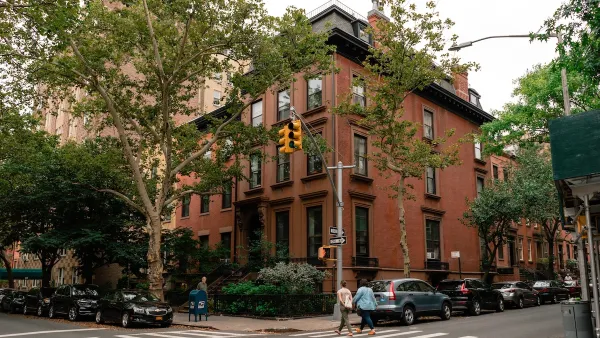
Mamdani sent nearly 6,000 pied-à-terre tax warnings to homes that didn’t qualify
A judge has ordered the administration to cancel thousands of pied-à-terre tax notices after it sent 35% of them erroneously.

Mamdani sent nearly 6,000 pied-à-terre tax warnings to homes that didn’t qualify
A judge has ordered the administration to cancel thousands of pied-à-terre tax notices after it sent 35% of them erroneously.

Detroit to transform waterfront with $2.2 billion investment
Developers will convert about 18 acres of unused parking lot space into civic spaces.

‘Going backwards:’ Baltimore mayor, students rally against state's transit funding plan
Maryland's proposed six-year plan provides no funding for Baltimore’s BMORE bus program and reduces its road maintenance funding.

FREE Course: Walkable City 1: Why Walkability?
After describing his path towards focusing on walkability as the essence of good planning, Jeff Speck marches through his five principal reasons for making more walkable places.
Reinventing Malls: Planning Alchemy—Turning Gray Fields Into Gold
The course focuses on the opportunities and imperatives that shape reinvention of mall sites.

City of Thousand Oaks
City of Wisconsin Rapids
Harvard University Graduate School of Design
The Architects Foundation
University of Cincinnati Online
Northern Illinois Transit Authority (NITA)
The Pocatello Development Authority
The Urban Renewal Agency of the City of Pocatello