A few key changes can help downtowns out of the ‘urban doom loop.’


How do we preserve crucial walkable urban places? Robert Steuteville seeks to answer this question in a piece for CNU Public Square, referencing a new report called Reiminaging Cities: Disrupting the Urban Doom Loop from Cushman & Wakefield with Christopher Leinberger and Places Platform.
The report outlines the importance of Walkable urban places (WalkUPs) as “efficient economic engines” that generate 57 percent of GDP while only taking up 3 percent of land in 15 major metro areas studied by the authors.
For decades, these urban centers focused on office buildings as the driving force. “Using portfolio theory to rebalance real estate toward less office space (work), more play (culture, entertainment, retail), and more residential (especially for-sale housing) would shift these urban centers back to the positive economic track they were on prior to COVID, the report concludes.”
Key recommendations include reducing the amount of office space and increasing residential units via conversion and new construction, increasing the diversity of businesses and services, and adding more amenities geared toward entertainment and recreation.
The report calls our current ‘doom loop’ an ‘episodic’ one that can be rectified through zoning and regulatory reform and a shift to accommodating more diverse uses and schedules.
Read the full story: How to reverse the ‘urban doom loop’

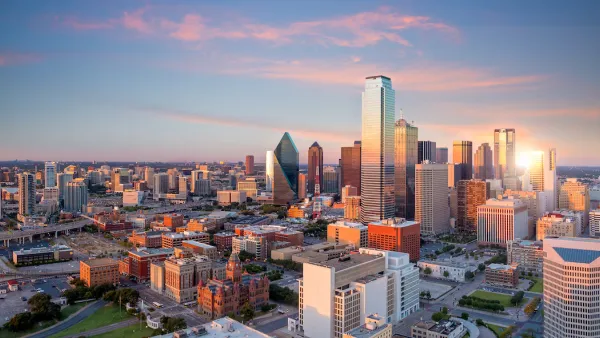
How the Post-Covid Reality Is Reshaping Central Business Districts and Urban Centers
U.S. cities are working to redefine their downtowns in response to the “donut effect:” people and businesses abandoning city centers and flocking to suburban areas and beyond.
Office Vacancies Drag Down Property Taxes
Downtown office buildings around the country are selling for much lower prices than before the pandemic, prompting questions about the future of central business districts.
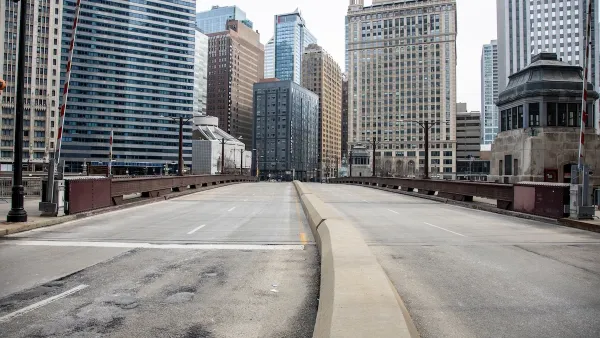
Major US Cities Still Suffering Downtown Decline
Research shows that the “donut effect” hollowing out central business districts since the pandemic continues to cause economic decline in the 12 largest American cities.

Planetizen Federal Action Tracker
A weekly monitor of how Trump’s orders and actions are impacting planners and planning in America.

California plans to bury El Niño’s downpour
If the state plays its cards right, it may be able to store a billion acre-feet of El Niño’s water in aquifers.

Desperate measures: Advocates weigh draining Lake Powell to fill Colorado River
Draining the reservoir could reduce evaporation losses by a couple hundred thousand acre-feet.

Chicago Avenue bridge construction delays enrages city leaders
The bridge has been closed since 2025. The city originally aimed to re-open it in December, and now expects to finish construction in 2027.

NYC bus network redesign speeds up Queens buses
Rush routes have seen a 4.6% speed increase after the redesign.

California High-Speed Rail Authority picks trainset manufacturer
The California High-Speed Rail Authority aims to start servicing passengers by 2033.

FREE Course: Walkable City 1: Why Walkability?
After describing his path towards focusing on walkability as the essence of good planning, Jeff Speck marches through his five principal reasons for making more walkable places.
Reinventing Malls: Planning Alchemy—Turning Gray Fields Into Gold
The course focuses on the opportunities and imperatives that shape reinvention of mall sites.

City of Rosemead
Rutgers University, Edward J. Bloustein School of Planning and Public Policy
One Hundred Miles
Hunter College, City University of New York (CUNY)
The Architects Foundation
University of Cincinnati Online
City of Cambridge
Montrose County
The Pocatello Development Authority