Downtown office buildings around the country are selling for much lower prices than before the pandemic, prompting questions about the future of central business districts.


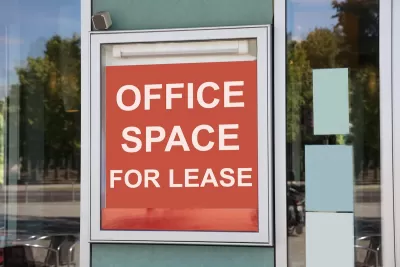
The sharp rise in office vacancies — and attendant drops in value for office buildings — could be worse than it appears, according to Professor Stijn Van Nieuwerburgh, who spoke with Governing’s Alan Greenblatt about the issue.
According to Van Nieuwerburgh, this is because “vacancy rates aren’t showing the whole picture, since there are still lots of leased offices that aren’t occupied or are under-occupied” as tenants wait out long-term leases, Greenblatt explains. Meanwhile, lower building values and higher mortgage rates mean that for many owners, it’s more profitable to walk away.
Van Nieuwerburgh warns that this slow-moving crisis will lead to a reduction in property taxes for cities. “In my view, we have permanently lower demand for office stock that is built on valuable land, so something else is the highest and best use for that land. The only option is to repurpose those buildings or that land.” However, Van Nieuwerburgh estimates that only 15 percent of office buildings are appropriate for residential conversion.
FULL STORY: Empty Downtowns Are Still Depleting Local Coffers

How the Post-Covid Reality Is Reshaping Central Business Districts and Urban Centers
U.S. cities are working to redefine their downtowns in response to the “donut effect:” people and businesses abandoning city centers and flocking to suburban areas and beyond.
Office Conversion Sees No Sign of Slowing
The adaptive reuse of office buildings for residential and other uses will grow by as much as 63 percent in 2024 over last year.
With Zero Office Conversions in Four Years, San Francisco Pins Hopes on New Special Financing District
City leaders hope the new incentive will spur the redevelopment of some of the city’s 30,000 square feet of vacant office space into housing.

Planetizen Federal Action Tracker
A weekly monitor of how Trump’s orders and actions are impacting planners and planning in America.

The state-sanctioned urbicide of Austin
People don’t kill cities. Freeways do.

US to reduce Colorado River water deliveries to Mexico
A new Colorado Treaty amendment reduces Mexico’s Colorado River water allocation by 250,000 acre feet.

5 New England states march closer to 800 megawatt wind energy project
Securing federal approval for the project may be complicated under the Trump administration, which has historically been hostile towards domestic wind power.

Baltimore to break ground on $50 million Transit Priority Project
The project will bring faster bus trips, safer streets and better bike connections to Baltimore.

Airbnb launches $250 million 'last-dollar financing' housing accelerator, makes first investment in Austin
The company will put $6.4 million towards affordable housing development in Texas’ capital.

FREE Course: Walkable City 1: Why Walkability?
After describing his path towards focusing on walkability as the essence of good planning, Jeff Speck marches through his five principal reasons for making more walkable places.
Reinventing Malls: Planning Alchemy—Turning Gray Fields Into Gold
The course focuses on the opportunities and imperatives that shape reinvention of mall sites.

Eagle County Government
Harvard University Graduate School of Design
Nashville Planning Department
The Architects Foundation
University of Cincinnati Online
The Pocatello Development Authority
The Urban Renewal Agency of the City of Pocatello
Journal of the American Planning Association