Many of California’s 6 million urban trees are reaching the end of their lives. Arborists in Long Beach are turning them into useful lumber.


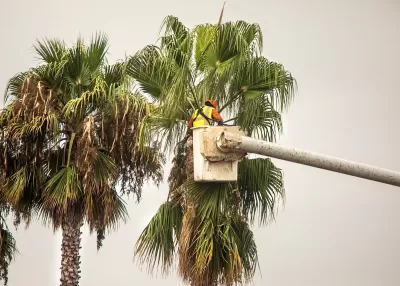
Arborists in California are developing a program to harvest and replace urban trees as they reach the end of their lives. As Noah Haggerty notes in an article in Governing, the project will prevent trees from falling onto and damaging homes or power lines while providing the state with a source of lumber.
Leaders at the Conservation Corps of Long Beach, which runs the current program, want to see it expand with more resources. “Right now, they’re working on and off with some borrowed equipment, but [executive director Dan Knapp] wants to see a crew of corps members dedicated to the project full time, with their own mill and kiln to dry the wood, and a storefront to sell it — all located on the same plot.” Trees milled by the Conservation Corps have already been used in homes and musical instruments.
Managing urban forests involves mapping every tree, understanding their conditions and ages, and knowing where trees are at risk from storms, pests, or encroachment, but such efforts require massive outlays of manual work. Experts say urban trees could replace as much as 10 percent of annual lumber needs in the United States, but many are currently being chopped up for mulch, reducing their carbon sequestration abilities.
Read the full story: California Has 6M Urban Trees. What Happens When They Die?
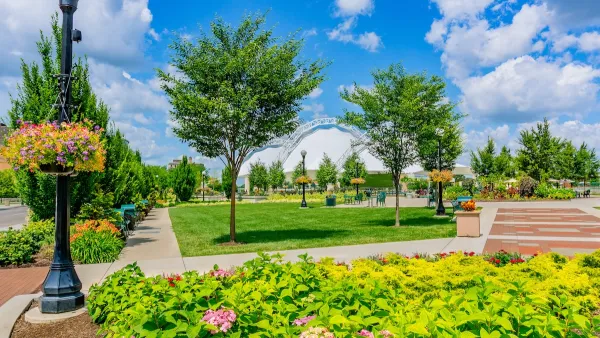
A Plan to Expand Tree Canopy Across Dayton
Dayton is developing an urban forest master plan, using a $2 million grant to expand its tree canopy, address decades of tree loss, and enhance environmental equity across the city.
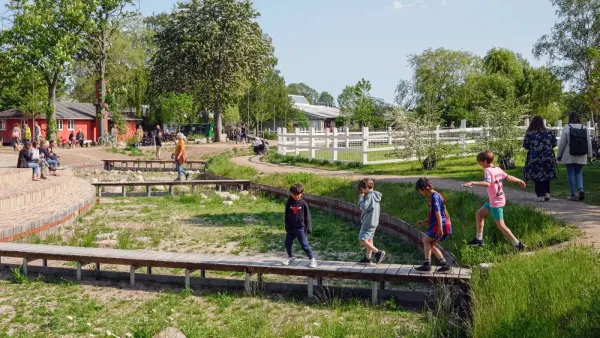
Copenhagen is losing its cool
In a city long designed to maximize light during dark Scandinavian winters, climate change is forcing the Danish capital to rethink its relationship with the sun.
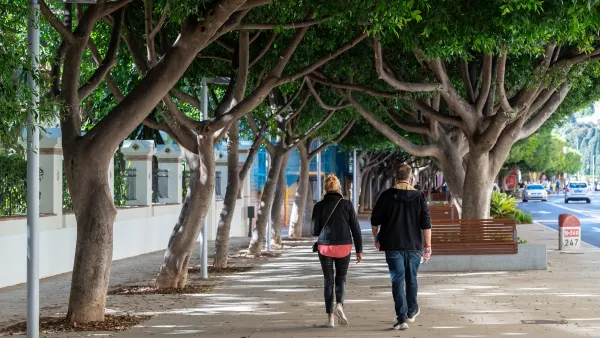
Green blocks are up to 4 degrees cooler than treeless streets
The difference in temperature created by urban trees can translate to as much as 40% less excess heat.

Desperate measures: Advocates weigh draining Lake Powell to fill Colorado River
Draining the reservoir could reduce evaporation losses by a couple hundred thousand acre-feet.

Eastern Nebraska is running out of electricity
Data centers and electrification are straining eastern Nebraska’s grid, throttling economic development.

Malls are becoming the midtowns of the future
Mall and office park redevelopments are a generational opportunity to create new nodes of urbanity.

NYC breaks ground on anti-flooding infrastructure project
New York City's new system will reduce stormwater flows to local sewers by 90%.

One Kentucky town’s secret to affordable housing
The Smoketown Community Land Trust has already built seven affordable homes for community members.

Houston gains petal-shaped cooling infrastructure to make streets more ‘delightful’
The city has installed the pavilions along 15 blocks in Houston.

FREE Course: Walkable City 1: Why Walkability?
After describing his path towards focusing on walkability as the essence of good planning, Jeff Speck marches through his five principal reasons for making more walkable places.
Reinventing Malls: Planning Alchemy—Turning Gray Fields Into Gold
The course focuses on the opportunities and imperatives that shape reinvention of mall sites.

City of Rosemead
Rutgers University, Edward J. Bloustein School of Planning and Public Policy
One Hundred Miles
University of Michigan School for Environment and Sustainability (SEAS)
Hunter College, City University of New York (CUNY)
The Architects Foundation
City of Cambridge
Montrose County
The Pocatello Development Authority