A prominent urbanist argues that redeveloping commercial corridors with denser housing could bridge the gap between the housing supply and demand.



Redeveloping major commercial corridors and adding housing to mixed-use developments could solve the housing crisis, according to Congress for New Urbanism co-founder Peter Calthorpe.
As Robert Steuteville explains in Public Square, Calthorpe calls this the “grand boulevard” strategy, noting that it “could be implemented with a basic form-based code with zero parking requirements.” According to Calthorpe, “A 15 percent inclusionary zoning requirement would create 300,000 affordable housing units in the Golden State.”
That strategy is central to a 2023 California state law, AB 2011, which allows for more mixed-use development and higher density in certain areas. “Using Urban Footprint software, Calthorpe analyzed a 43-mile commercial corridor between San Francisco and San Jose, the El Camino Real. Reimagining this as a grand boulevard allows 3,500 acres of infill development, with up to 250,000 dwelling units—some with ground-floor commercial space.” In fact, infill development on Bay Area commercial corridors could create over 1 million new housing units.
According to Calthorpe, “Transit service would be greatly expanded if larger corridors were served with buses. Water use, energy use, driving, greenhouse gas emissions, and household transportation costs could be substantially reduced, he argues.”
FULL STORY: Grand boulevards would solve the housing crisis, Calthorpe says

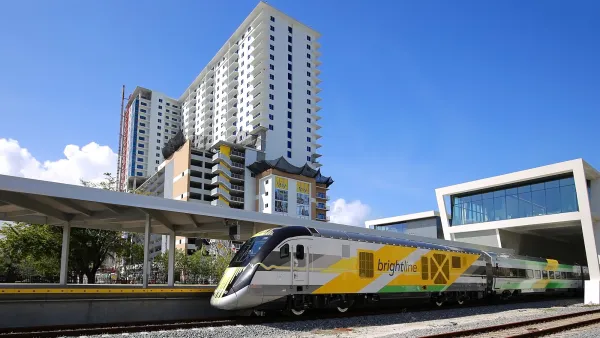
House Bill Would Incentivize Housing Near Transit
The Build HUBS Act intends to make federal funding for TOD more available and streamline permitting for transit-adjacent housing.
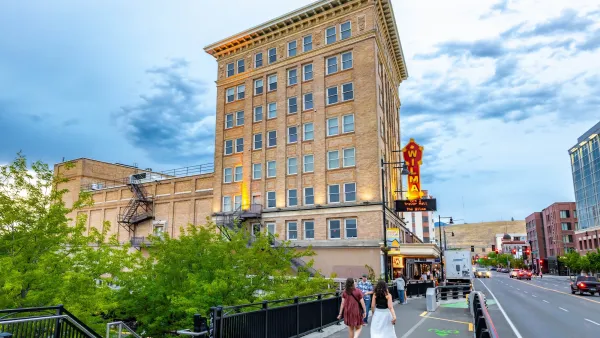
Missoula Approves Zoning Reform Emphasizing More Diverse Housing, Walkability
The city’s new zoning code, map, and development standards will guide more expansive housing options and improved walkability.
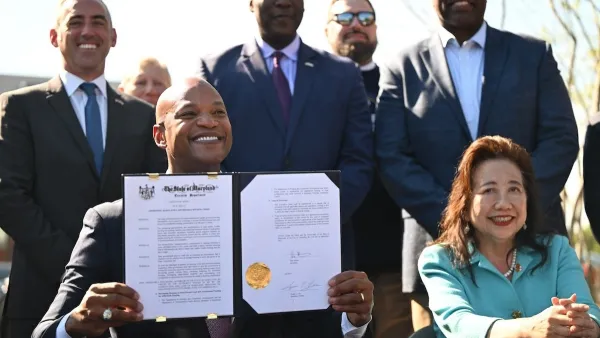
Maryland Issues Executive Order to Create Affordable Housing on State-Owned Properties
Gov. Wes Moore’s order, which follows on the heels of an unsuccessful attempt to pass the housing reforms in the legislature, prioritizes transit-oriented development and streamlines permitting.

The state-sanctioned urbicide of Austin
People don’t kill cities. Freeways do.

US to reduce Colorado River water deliveries to Mexico
A new Colorado Treaty amendment reduces Mexico’s Colorado River water allocation by 250,000 acre feet.

New Jersey’s second-largest city bans standalone data centers
Jersey City will continue to allow co-location facilities, such as those meant for research institutions that store their own data.

Amtrak not solely to blame for New Jersey commuter rail's unreliability, report finds
A new study from the Garden State Initiative found that NJ Transit’s budget grew 20% across a 4 year period, but reliability declined significantly over the same period.

EPA erases limits on planet-warming pollution from power plants
Under Monday’s plan, power plants would still have some limits on how much mercury, arsenic and other contaminants they can emit.

Phoenix announces new on-demand transit service, more frequent RAPID buses
Both new services will launch in October, and are part of Phoenix's Project Effective Access Solutions for Easing Congestion.

FREE Course: Walkable City 1: Why Walkability?
After describing his path towards focusing on walkability as the essence of good planning, Jeff Speck marches through his five principal reasons for making more walkable places.
Reinventing Malls: Planning Alchemy—Turning Gray Fields Into Gold
The course focuses on the opportunities and imperatives that shape reinvention of mall sites.

Eagle County Government
Harvard University Graduate School of Design
Nashville Planning Department
The Architects Foundation
University of Cincinnati Online
The Pocatello Development Authority
The Urban Renewal Agency of the City of Pocatello
Journal of the American Planning Association