The Downtown Activation Plan shifts from Euclidean to form-based zoning to encourage more commercial development.



Seattle Mayor Bruce Harrell’s recently unveiled Downtown Activation Plan significantly expands the types of businesses permitted in the city’s central core as part of an effort to revitalize the district.
Current rules, based in Euclidean zoning, prohibit businesses such as arts studios, medical offices, and printing shops from downtown Seattle. Harrell wants to fill vacant storefronts and transform downtown Seattle into a thriving, mixed-use neighborhood.
As Alan Ehrenhalt explains in Governing, “The idea was to keep downtown streets free of noxious enterprises such as factories and sweatshops that would be a nuisance to nearby residences. As the decades went by, however, the list of proscribed businesses grew in many places beyond the bounds of logic.”
Now, a shift toward form-based codes promotes a new way of thinking about zoning: “Instead of regulating commercial spaces according to what goes on within them, we should largely forget about uses and regulate design — how well a structure relates to its surroundings and how it works aesthetically.” Another planning concept, the ‘Gehl door average,’ uses the number of doors in a given commercial block as a proxy for vibrancy.
Read the full story: The Obsolete Zoning Laws that Leave Downtowns Stagnant

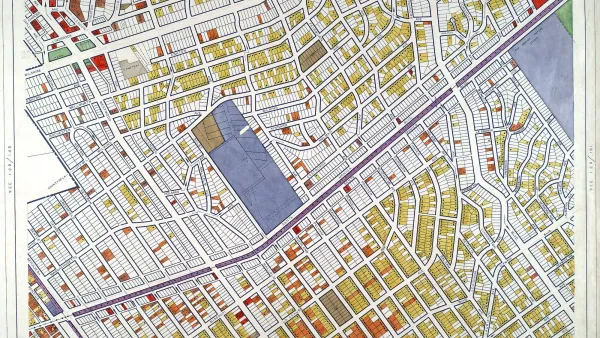
100 Years ago, Zoning Changed how US Cities Grow. Today, it is Ripe for Reform.
Euclidean zoning was enshrined in U.S. town planning by a 1926 Supreme Court decision. Cities are recognizing it’s time for some drastic changes.

Arlington’s New Form-Based Zoning Designed to Guide a Cohesive Public Realm
Form-based zoning focuses on the design of buildings and how they interact with the public realm.

Seattle Adopts a New Growth Plan, but Major Zoning Battles are Just Beginning
Approving the comprehensive plan update is just the first step in rewriting the city’s zoning code to accommodate more density and affordable housing.

Planetizen Federal Action Tracker
A weekly monitor of how Trump’s orders and actions are impacting planners and planning in America.

California plans to bury El Niño’s downpour
If the state plays its cards right, it may be able to store a billion acre-feet of El Niño’s water in aquifers.

Chicago breaks ground on $3 billion megadevelopment
The new neighborhood, titled Foundry Park, will one day host 3,700 residences.

Satanic place names
From streams and lakes to valleys and canyons, I mapped more than 1,000 places named after the Devil.

California High-Speed Rail Authority CEO resigns after $600,000 scandal
Under Ian Choudri, the authority used taxpayer dollars to fund first class flights and trips to nightclubs.

Want to study the Missouri River? Soon, you may need unanimous approval from 10 states
Legislation would require 10 governors’ permission to study or build projects moving water outside the basin.

FREE Course: Walkable City 1: Why Walkability?
After describing his path towards focusing on walkability as the essence of good planning, Jeff Speck marches through his five principal reasons for making more walkable places.
Reinventing Malls: Planning Alchemy—Turning Gray Fields Into Gold
The course focuses on the opportunities and imperatives that shape reinvention of mall sites.

City of Rosemead
Rutgers University, Edward J. Bloustein School of Planning and Public Policy
One Hundred Miles
Hunter College, City University of New York (CUNY)
The Architects Foundation
University of Cincinnati Online
City of Cambridge
Montrose County
The Pocatello Development Authority