Seven grant awards totaling $162 million will be used for planning, capital projects, and regional partnerships to reduce environmental harm and improve access in disadvantaged communities.


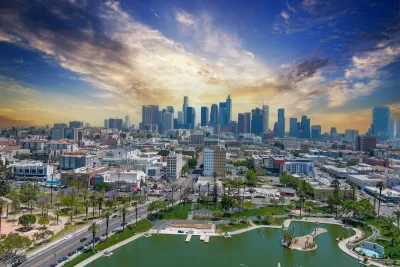
Administered by the U.S. Department of Transportation (DOT), the Reconnecting Communities and Neighborhoods (RCN) Program seeks to:
- Prioritize disadvantaged communities;
- Improve access to daily needs such as jobs, education, healthcare, food, and recreation;
- Foster equitable development and restoration;
- Reconnect communities by removing, retrofitting, or mitigating highways or other transportation facilities that create barriers to community connectivity, including to mobility, access, or economic development.
As reported by Joe Linton in this article, RCN grants totaled $237 million for California. Of that, L.A. County secured about two-thirds: $162 million. Over 90 percent of this funding goes to Metro, nearly all of that for one $139 million grant to fund 14 miles of bus priority lanes, 23 miles of bus corridor enhancements (i.e. transit signal priority, all door boarding, and bus shelters), 60 Metro Bike Share stations plus first-last-mile improvements, and five mobility hubs.
Three of the grants for L.A. County seek to reconnect and/or expand parkland, including:
- $800,000 to L.A. County for the Reconnecting East Los Angeles: 60 Green Bridge Project for Belvedere Park - planning. The county will plan for a cap to be developed over the 60 Freeway bridging the two sides of Belvedere Park, near the East L.A. Civic Center, the current terminus of the Metro E Line.
- $2 million to L.A. City for Reconnecting MacArthur Park - planning. Championed by L.A. City Councilmember Eunisses Hernandez, this project would plan for permanently closing Wilshire Boulevard from Alvarado Street to Carondelet Street and bridging the two sides of MacArthur Park.
- $3.6 million to Friends of Hollywood Central Park (FHCP) for Healing Hollywood - planning. The nonprofit organization FHCP is planning a large scale (37.6 acre) park capping the 101 Freeway, which will include five miles of walk/bike paths and more.
For more information, please read the source article.
FULL STORY: Rundown of New Federal Reconnecting Communities Grants for L.A. County

Congress Moves to End Reconnecting Communities and Related Grants
The House Transportation and Infrastructure Committee moved to rescind funding for the Neighborhood Equity and Access program, which funds highway removals, freeway caps, transit projects, pedestrian infrastructure, and more.
Highway Removal Slowed by Outdated Policy, Lack of Committed Funding
Resistance from state transportation departments and precarious funding sources mean highway removal projects are few and far between, despite their benefits.
Bridging Divides: The Crucial Role of Collaboration in Highway Removal
Highway removal is most successful when agencies at all levels of government work closely with each other and the impacted community.

Planetizen Federal Action Tracker
A weekly monitor of how Trump’s orders and actions are impacting planners and planning in America.

The state-sanctioned urbicide of Austin
People don’t kill cities. Freeways do.

US to reduce Colorado River water deliveries to Mexico
A new Colorado Treaty amendment reduces Mexico’s Colorado River water allocation by 250,000 acre feet.

5 New England states march closer to 800 megawatt wind energy project
Securing federal approval for the project may be complicated under the Trump administration, which has historically been hostile towards domestic wind power.

Baltimore to break ground on $50 million Transit Priority Project
The project will bring faster bus trips, safer streets and better bike connections to Baltimore.

Airbnb launches $250 million 'last-dollar financing' housing accelerator, makes first investment in Austin
The company will put $6.4 million towards affordable housing development in Texas’ capital.

FREE Course: Walkable City 1: Why Walkability?
After describing his path towards focusing on walkability as the essence of good planning, Jeff Speck marches through his five principal reasons for making more walkable places.
Reinventing Malls: Planning Alchemy—Turning Gray Fields Into Gold
The course focuses on the opportunities and imperatives that shape reinvention of mall sites.

Eagle County Government
Harvard University Graduate School of Design
Nashville Planning Department
The Architects Foundation
University of Cincinnati Online
The Pocatello Development Authority
The Urban Renewal Agency of the City of Pocatello
Journal of the American Planning Association