How an ‘ecovoltaic’ approach can balance energy production with conservation of sensitive land.


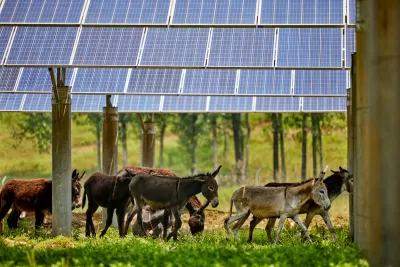
A team of researchers at Colorado State University is looking at ways to lessen the impacts of solar energy production on the environment and reduce conflicts with animal migration, agriculture, ranching, and conservation.
As Matthew Sturchio explains in Honolulu Civil Beat, “A growing alternative to using land solely for solar power generation is called agrivoltaics. As its name suggests, this strategy combines agriculture and solar power on the same piece of land. Agrivoltaic projects can take place on croplands, grazing lands and habitat for agriculturally important pollinators.”
In some of these cases, the shade thrown by solar panels creates micro-environments that benefit different plant communities. “In some cases, mixed conditions like these, with varying levels of light and water, can be a good thing. A well-tested concept in restoration ecology – the science of restoring damaged ecosystems – is that environments with more variety support more diverse mixes of plants and animals.”
Sturchio notes that the location of power transmission lines and ease of access to them also frequently dictate where solar projects can be placed. “New transmission projects that ease this geographic constraint could provide more options. With greater flexibility in choosing sites, developers could shift away from highly sensitive natural ecosystems and install solar arrays on abandoned, water-limited or otherwise degraded lands instead.”
FULL STORY: Solar Power Takes Up A Lot Of Land. Here’s How It Can Be More Ecologically Beneficial

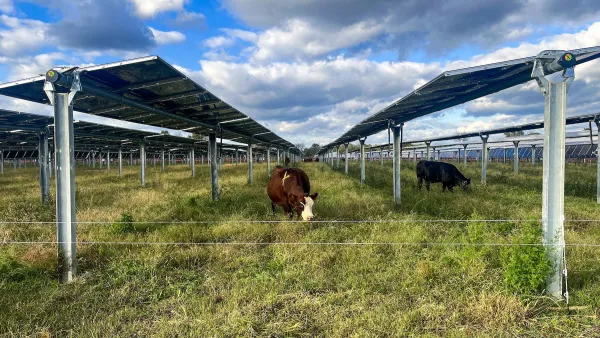
Cows at Tennessee's 'Silicon Ranch' graze under solar panels
The project aims to prove that agriculture and solar energy production can work in tandem.
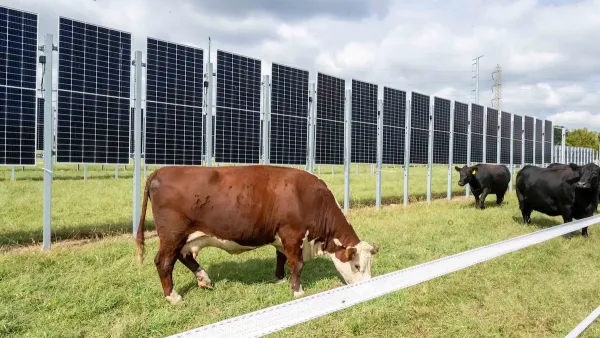
New Jersey Agrivoltaic Project Combines Solar Energy With Farming
A Rutgers University-New Brunswick demonstration farm will evaluate solar array designs to understand how they can best support grazing and agriculture on the same site.
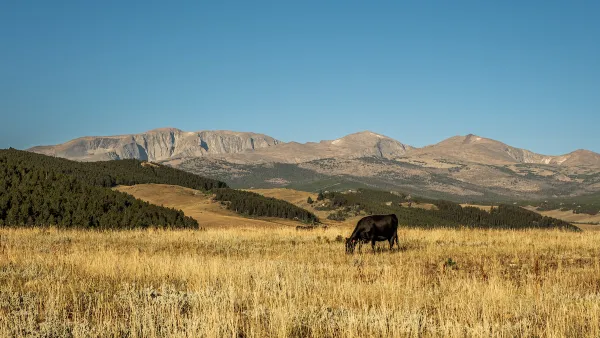
Montana Ranchers Question Massive Solar Project
The $1.2-billion solar farm would provide power to data centers owned by Microsoft, Meta, and others.

Planetizen Federal Action Tracker
A weekly monitor of how Trump’s orders and actions are impacting planners and planning in America.

The state-sanctioned urbicide of Austin
People don’t kill cities. Freeways do.

US to reduce Colorado River water deliveries to Mexico
A new Colorado Treaty amendment reduces Mexico’s Colorado River water allocation by 250,000 acre feet.

5 New England states march closer to 800 megawatt wind energy project
Securing federal approval for the project may be complicated under the Trump administration, which has historically been hostile towards domestic wind power.

Baltimore to break ground on $50 million Transit Priority Project
The project will bring faster bus trips, safer streets and better bike connections to Baltimore.

Airbnb launches $250 million 'last-dollar financing' housing accelerator, makes first investment in Austin
The company will put $6.4 million towards affordable housing development in Texas’ capital.

FREE Course: Walkable City 1: Why Walkability?
After describing his path towards focusing on walkability as the essence of good planning, Jeff Speck marches through his five principal reasons for making more walkable places.
Reinventing Malls: Planning Alchemy—Turning Gray Fields Into Gold
The course focuses on the opportunities and imperatives that shape reinvention of mall sites.

Eagle County Government
Harvard University Graduate School of Design
Nashville Planning Department
The Architects Foundation
University of Cincinnati Online
The Pocatello Development Authority
The Urban Renewal Agency of the City of Pocatello
Journal of the American Planning Association