Residents and businesses can choose from a list of eligible trees to support efforts to boost urban tree canopies and help with stormwater retention.


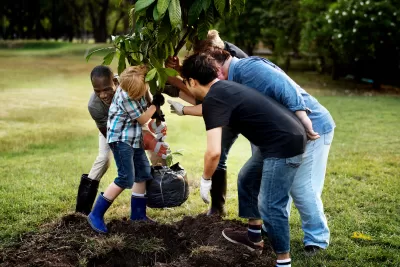
A Smart Cities Dive brief by Ysabelle Kempe outlines a new program from the Metropolitan Water District of Southern California that offers residents and businesses a $100 rebate for each tree they plant on their property.
The district provides a list of preferred trees that require less water and have high stormwater retention. “Rebate participants are expected to purchase and plant the trees themselves, although the water district created a guide to tree planting and maintenance.”
As Kempe explains, “The tree rebate is a new addition to a turf replacement program that has helped property owners replace 218 million square feet of ‘water-sucking’ lawns with sustainable landscapes, the district says, which has saved enough water to serve about 68,000 homes each year.”
Read the full story: Planting a tree just got $100 cheaper for property owners in a California water district

LA’s Tree Emergency Goes Beyond Vandalism
After a vandal destroyed dozens of downtown LA trees, Mayor Karen Bass vowed to replace them. Days later, she slashed the city’s tree budget.
Updating LA’s Tree Rules Could Bring More Shade to Underserved Neighborhoods
A new USC study finds that relaxing Los Angeles’ outdated tree planting guidelines could significantly expand urban tree canopy and reduce shade disparities in lower-income neighborhoods, though infrastructure investments are also needed.
‘Stockholm Tree Pit’ Saves Dying Urban Trees
After noticing that two-thirds of its trees were dying, Stockholm developed a new planting method to protect trees surrounded by concrete.

Planetizen Federal Action Tracker
A weekly monitor of how Trump’s orders and actions are impacting planners and planning in America.

Amtrak, CN end decades-long dispute with eight-year agreement
The new operating agreement establishes an updated framework for the companies to work together, including processes to resolve disputes.

Judges permit Denver to divert 77,000 acre feet from the Colorado River for reservoir expansion
Overuse and climate change have caused the Colorado River’s water levels to plummet.

Boston has spent millions making the Green Line more accessible — and there’s no end in sight
While the city has invested millions into expanding and adding platforms to the Green Line to make it more accessible, new train cars set to arrive next year will be too tall for disabled passengers to board without raising the current platforms.

Idaho may see an 18% drop in federal surface transit funding — the largest estimated cut in the US
Transit systems in rural communities are much more reliant on federal funding to provide their services.

How ‘post-disaster gentrification’ alters neighborhoods after natural calamities
After hurricanes, fires or other calamities, the original residents of a community are often replaced by younger, wealthier residents.

FREE Course: Walkable City 1: Why Walkability?
After describing his path towards focusing on walkability as the essence of good planning, Jeff Speck marches through his five principal reasons for making more walkable places.
Reinventing Malls: Planning Alchemy—Turning Gray Fields Into Gold
The course focuses on the opportunities and imperatives that shape reinvention of mall sites.

City of Wisconsin Rapids
Harvard University Graduate School of Design
KFH Group Inc.
The Architects Foundation
University of Cincinnati Online
The Pocatello Development Authority
The Urban Renewal Agency of the City of Pocatello