After noticing that two-thirds of its trees were dying, Stockholm developed a new planting method to protect trees surrounded by concrete.


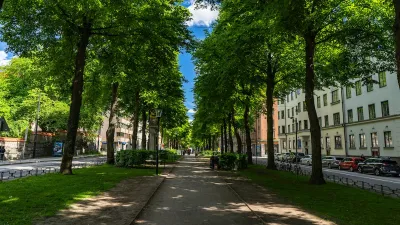
A method for planting trees in concrete-laden urban spaces is taking root — excuse the pun — across Europe, reports Peter Yeung for Reasons to be Cheerful. The “Stockholm tree pit” is an innovation created in Stockholm, Sweden as a response to an assessment of the city’s trees that found two-thirds of the city’s trees were dead or dying.
“The design involves digging a pit and constructing a frame underground around the tree’s roots, and then filling said pit with a mixture of soil and stone, sometimes including biochar, to both aerate and fertilize the soil.” The permeable layers allow the tree to receive stormwater and air than they would in traditional soil surrounded by paved spaces.
“Proponents say the method has a number of benefits, including the fact that pits can be installed around existing trees, they can bear the weight of heavy-vehicle traffic, they require little topsoil — a resource that is becoming scarce — and they need less watering than traditionally-planted trees.” Trees that use the pits are growing to larger sizes and absorb and filter more rainwater. “The municipality estimates that 2.3 million liters of rainwater are managed by the trees per year, and consequently, 4,600 square meters of roofs and sidewalks have been disconnected from the sewage system, reducing the burden on water treatment services.”
FULL STORY: How Stockholm Is Sprouting Healthy Trees From Concrete

LA’s Tree Emergency Goes Beyond Vandalism
After a vandal destroyed dozens of downtown LA trees, Mayor Karen Bass vowed to replace them. Days later, she slashed the city’s tree budget.

Updating LA’s Tree Rules Could Bring More Shade to Underserved Neighborhoods
A new USC study finds that relaxing Los Angeles’ outdated tree planting guidelines could significantly expand urban tree canopy and reduce shade disparities in lower-income neighborhoods, though infrastructure investments are also needed.
Forest Service Rescinds Tree Planting Grants
The $75 million program fell victim to the federal government’s purge of ‘DEI’-related projects.

Planetizen Federal Action Tracker
A weekly monitor of how Trump’s orders and actions are impacting planners and planning in America.

The state-sanctioned urbicide of Austin
People don’t kill cities. Freeways do.

US to reduce Colorado River water deliveries to Mexico
A new Colorado Treaty amendment reduces Mexico’s Colorado River water allocation by 250,000 acre feet.

5 New England states march closer to 800 megawatt wind energy project
Securing federal approval for the project may be complicated under the Trump administration, which has historically been hostile towards domestic wind power.

Baltimore to break ground on $50 million Transit Priority Project
The project will bring faster bus trips, safer streets and better bike connections to Baltimore.

Airbnb launches $250 million 'last-dollar financing' housing accelerator, makes first investment in Austin
The company will put $6.4 million towards affordable housing development in Texas’ capital.

FREE Course: Walkable City 1: Why Walkability?
After describing his path towards focusing on walkability as the essence of good planning, Jeff Speck marches through his five principal reasons for making more walkable places.
Reinventing Malls: Planning Alchemy—Turning Gray Fields Into Gold
The course focuses on the opportunities and imperatives that shape reinvention of mall sites.

Eagle County Government
Harvard University Graduate School of Design
Nashville Planning Department
The Architects Foundation
University of Cincinnati Online
The Pocatello Development Authority
The Urban Renewal Agency of the City of Pocatello
Journal of the American Planning Association