Big problems need big solutions.



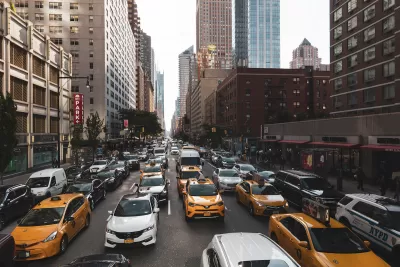
What would happen if we found a solution that could alleviate vehicular traffic in the most populous city in the United States? What would happen if this solution could also generate hundreds of millions of dollars in revenue for public use? What would happen if this solution could also reduce carbon emissions and increase the overall quality of life?
It would have to be revolutionary, right? The good news is we do not have to wonder because it already exists—and it has been proven to work around the world with amazing success. Yes, I am talking about congestion pricing.
We all have heard about New York City’s congestion pricing plan. And, to be clear, all the buzz is rightfully deserved. The implementation of congestion pricing might be one of the most critical transportation projects that could happen in the near future in the Big Apple. Since its introduction in 2019, congestion pricing has come a long way. Yet despite all of its progress and support from New York City Mayor Eric Adams, New York Governor Kathy Hochul, and even the Federal Highway Administration, the program has still faced rough political opposition.
To understand why congestion pricing is necessary, and why is it so controversial despite several successful case studies, we need to understand two things: how congestion pricing works and why its use is well suited for New York City.
For the purpose of this article, we just need to understand two things. New York’s plan is a type of congestion pricing strategy known as zone-based pricing (meaning it charges drivers to enter a certain zone), and congestion pricing at heart is just a congestion reduction strategy. This is done with the congestion charge or toll, which occurs when a driver enters a certain zone and varies according to real-time congestion data. It is simple: if congestion goes up, then the toll goes up. A higher toll discourages drivers from entering a zone at peak congestion, distributing nonessential trips to other times of day when congestion is lower. This decreases the accumulation of motor vehicles at one specific time and hence reduces overall congestion. In New York’s case, this zone includes all of Manhattan at and below 60th Street, with exemptions for FDR Drive andthe West Side Highway/Route 9A.
The fact that New York City is the pilot city for America’s first congestion charge zone is no coincidence. In my opinion, there is no better city for this program than the Big Apple.
Around the United States, car travel typically encompasses a vast majority of trips. But in the ‘city that never sleeps,’ this is not true at all. Car use is far lower in New York than in the typical American city. According to a report from the New York City Department of Planning, 58 percent of the city's commuters travel via public transit, compared with the national average of 5 percent. If we look into Manhattan, the number is even bigger. Out of all people commuting to the island, 79 percent choose transit or another mode of non-car-based transportation for their daily commute. To put this into perspective, despite motor vehicles only representing 21 percent of trips to the island, they still cause the famous gridlock traffic Manhattan is known for. Now, imagine if an extra 5 or 10 percent of commuters drove into Manhattan. I will leave this to the public’s imagination.
Drivers might say, “Wait! I paid for the right to gridlock Manhattan through the gas tax and other tolls! I paid for the road already.” And if these statements were 100 percent true, they might be justified to a certain extent. However, the truth tells another story. According to a report published by the Frontier Groups and U.S. PIRG Education Fund, roads do not “pay for themselves.” In reality, they are subsidized by the government. “Since 1947, the amount of money spent on highways, roads, and streets has exceeded the amount raised through gasoline taxes and other so-called ‘user fees’ by $600 billion (2005 dollars), representing a massive transfer of general government funds to highways.” (p.1). This helps us understand that a “congestion charge” would do nothing more than help reduce this giant deficit, giving the government more capital to use in important projects. It is not a matter of unfairness; rather, it is about paying for the true cost of using the road.
Some might argue that, even if that is true, low-income individuals might not be able to pay. However, those who drive to Manhattan happen to be the higher-earning segment of commuters. According to a Tri-State Transportation campaign report, public transit commuters have a lower median income than commuters who drive to Manhattan, earning approximately $20,000 less than car commuters per year. Now, addressing the outliers of the statistic, which could be lower-income individuals with no other option but to drive, the solution is simple: subsidize their commutes. If we are already subsidizing the majority of drivers who do not need to be subsidized, why not subsidize the small percentage that actually need it? In this way, congestion pricing and equity can go hand in hand.
A slogan on the MTA’s Twitter page reads, “We move the region that moves the world.” In the most populous American city where most people travel via transit, they surely do. To this end, congestion pricing will also help the MTA on its mission of improving mobility in the city by giving them as much as one billion dollars of revenue per year. According to Reuters, a study shows that the congestion pricing program would reduce the number of cars entering the island by 15 to 20 percent, improving air quality at the same time. The program will have exemptions, which include individuals with disabilities, residents of the congestion charge zone, and emergency vehicles.
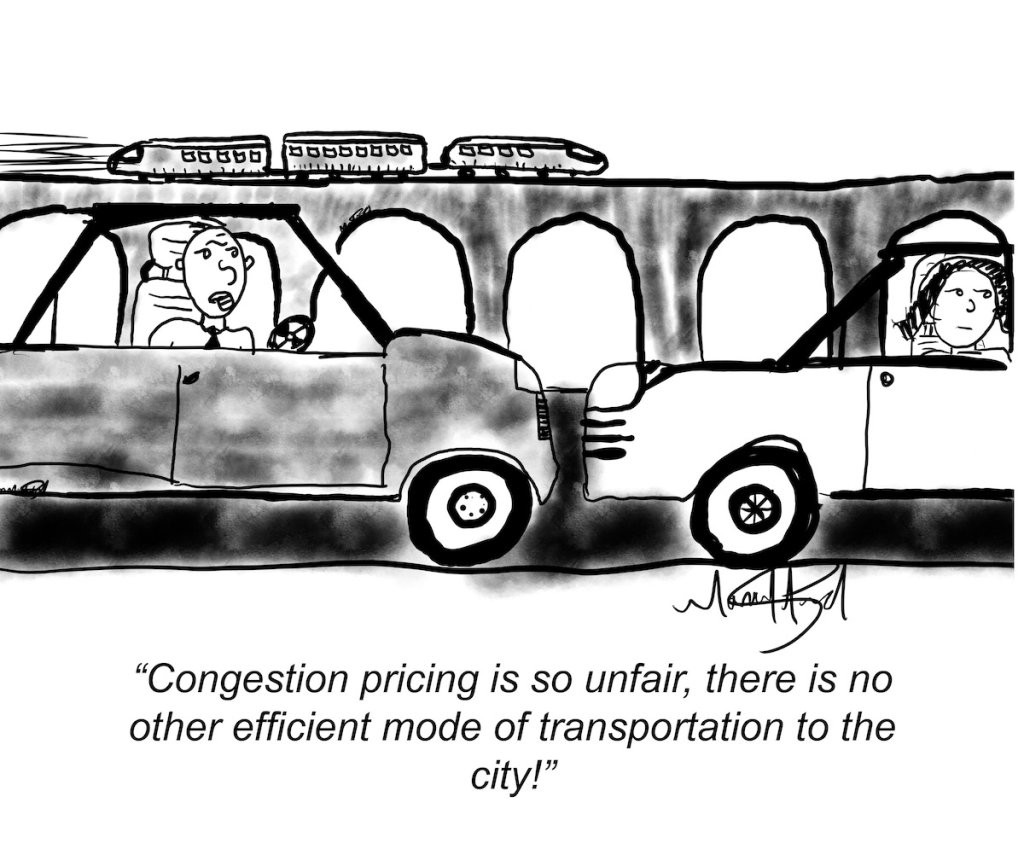
Congestion pricing is in the best interest of New Yorkers, as most people already commute by transit and do not drive. It also reveals the real cost of driving, and it is only fair that drivers pay for what they use, reducing government subsidies. Congestion pricing provides valuable capital to keep supporting one of the most important transit systems in the world. In a time when climate change is imminent, the environmental benefits can’t be overlooked. Cities around the globe have used this tool and reaped its benefits. New York leaders seem to know this. Hopefully, congestion pricing’s critics can see it too.

Tri-State Economies to Lose Billions From Congestion Pricing Pause
New York City’s congestion pricing program, suspended by Governor Hochul earlier this year, would have pumped $12 billion into local projects and jobs.
Judge Extends NYC Congestion Pricing Through at Least June 9
A federal judge halted the Trump administration’s effort to kill the program, which remains in limbo as a lawsuit filed by the MTA moves forward.
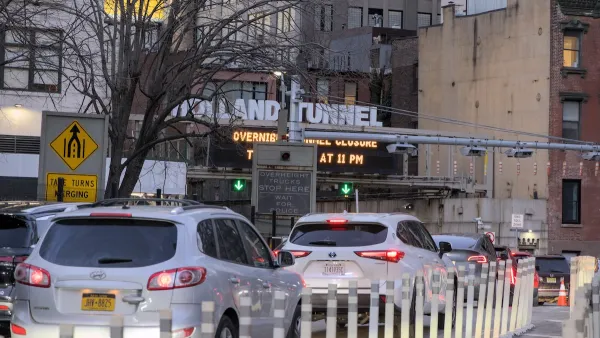
NYC Congestion Pricing Continues to Show Positive Results
While the Trump administration attempts to revoke the program’s federal approval, congestion pricing continues to reduce traffic, speed up bus travel times, and improve air quality in Manhattan.

The state-sanctioned urbicide of Austin
People don’t kill cities. Freeways do.

US to reduce Colorado River water deliveries to Mexico
A new Colorado Treaty amendment reduces Mexico’s Colorado River water allocation by 250,000 acre feet.

New Jersey’s second-largest city bans standalone data centers
Jersey City will continue to allow co-location facilities, such as those meant for research institutions that store their own data.

Amtrak not solely to blame for New Jersey commuter rail's unreliability, report finds
A new study from the Garden State Initiative found that NJ Transit’s budget grew 20% across a 4 year period, but reliability declined significantly over the same period.

EPA erases limits on planet-warming pollution from power plants
Under Monday’s plan, power plants would still have some limits on how much mercury, arsenic and other contaminants they can emit.

Phoenix announces new on-demand transit service, more frequent RAPID buses
Both new services will launch in October, and are part of Phoenix's Project Effective Access Solutions for Easing Congestion.

FREE Course: Walkable City 1: Why Walkability?
After describing his path towards focusing on walkability as the essence of good planning, Jeff Speck marches through his five principal reasons for making more walkable places.
Reinventing Malls: Planning Alchemy—Turning Gray Fields Into Gold
The course focuses on the opportunities and imperatives that shape reinvention of mall sites.

Eagle County Government
Harvard University Graduate School of Design
Nashville Planning Department
The Architects Foundation
University of Cincinnati Online
The Pocatello Development Authority
The Urban Renewal Agency of the City of Pocatello
Journal of the American Planning Association

