Moab adopted a Sustainability Action Plan to map out goals and strategies for the pursuit of sustainability, including the reduction of greenhouse gas emissions. The plan was approved by the Moab City Council on December 12, 2023.


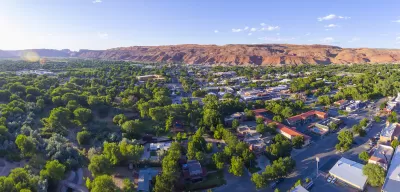
Located in eastern Utah, Moab is probably best known as the gateway to the massive red rock formations in Arches National Park. However, as reported in this article by Alison Harford, Moab should also be recognized for its efforts to advance sustainability, as exemplified by the recent adoption of its Sustainability Action Plan. This plan represents the culmination of an eight-month planning effort and reflects the community’s interests and needs for clean air, clean water, and a livable environment. The planning process included public outreach activities to inform the development of the priorities, a survey to collect public input, an open house, and numerous technical advisory committee meetings.
The plan lays out ambitious goals, such as achieving an 80 percent reduction in greenhouse gas emissions by 2040 and achieving a 100 percent renewable electricity supply community-wide by 2030. The city also wants to gain certification to the International Dark Skies Association in 2024, and plans to create a “Transportation Electrification Plan” to identify “policies and strategies to prepare for projected electric vehicle adoption and charging demand.”
Moab has made steady progress in its sustainability efforts. In 2004, the city became the nation’s first EPA Green Power Community by exceeding a minimum threshold of voluntary green power purchases. By 2009, the city the 2020 Vision: A Sustainable Moab Plan which includes goals for water conservation, water reuse, energy efficiency, sustainable construction, retrofitting for sustainability, and community awareness. Since then, Moab has continued to pursue sustainability in its initiatives and goals. In 2017, Moab committed to 100% renewable electricity by 2032 and an 80% reduction in greenhouse gases by 2040. In 2019, the city moved the date to 2030 to source 100% renewable electricity and become an anchor community for the Utah 100 Communities program enabled by House Bill 411.
Read the full story: City adopts Sustainability Action Plan


Op-ed: if transit agencies want sustainability, they should focus on their buildings
In the Washington region, buildings can account for nearly 70% of greenhouse gas emissions. If WMATA wants to be a sustainable agency, it must upgrade its developments as well as its transit.

Swapping your gas car for an EV is greener than keeping it, research shows
An EV repays the 'carbon debt' caused by building it after 4,400 miles.

Climate change could double household water costs in some cities, study finds
New research suggests that climate change-related stressors are straining municipal water systems.

Planetizen Federal Action Tracker
A weekly monitor of how Trump’s orders and actions are impacting planners and planning in America.

California plans to bury El Niño’s downpour
If the state plays its cards right, it may be able to store a billion acre-feet of El Niño’s water in aquifers.

Desperate measures: Advocates weigh draining Lake Powell to fill Colorado River
Draining the reservoir could reduce evaporation losses by a couple hundred thousand acre-feet.

California city breaks ground on transit connector
The project includes three mobility hubs and a pedestrian bridge.

After public outcry, Massachusetts city releases housing development tracker
Cambridge’s tracker currently shows 250 housing projects in various stages of development.

40 years after approval, Chicago breaks ground on new park
The park honors Jean Baptiste Point du Sable, the city’s first permanent non-native settler.

FREE Course: Walkable City 1: Why Walkability?
After describing his path towards focusing on walkability as the essence of good planning, Jeff Speck marches through his five principal reasons for making more walkable places.
Reinventing Malls: Planning Alchemy—Turning Gray Fields Into Gold
The course focuses on the opportunities and imperatives that shape reinvention of mall sites.

City of Rosemead
Rutgers University, Edward J. Bloustein School of Planning and Public Policy
One Hundred Miles
Hunter College, City University of New York (CUNY)
The Architects Foundation
University of Cincinnati Online
City of Cambridge
Montrose County
The Pocatello Development Authority