The high-speed rail line will cut travel time between Southern California and Las Vegas roughly in half.



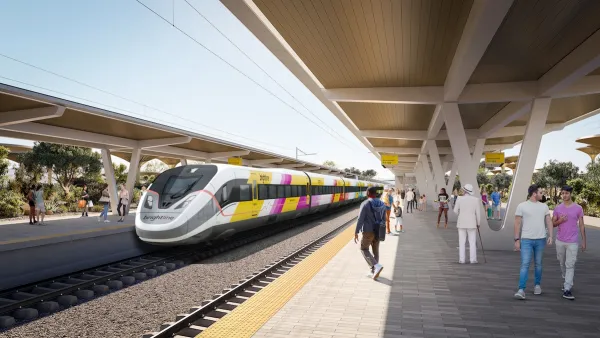
The Brightline West high-speed rail (HSR) project connecting Las Vegas to Southern California and Los Angeles-bound conventional trains received $3 billion in funding from the Bipartisan Infrastructure Law, pushing the train one step closer to reality, reports Caitlin Lilly for Fox 5.
The line will primarily use existing right-of-way along Interstate 15 and culminate at Rancho Cucamonga, where travelers can connect to the Metrolink commuter rail system. The line, as currently planned, will have four total stops and could begin operating in 2027.
Brightline already operates a high-speed rail service in Florida that connects Miami to Orlando. According to a press release from Nevada Senator Jacky Rosen, the train will “bring more visitors to our state, reduce traffic on the I-15, create thousands of good paying jobs, and decrease carbon emissions, all while relying on local union labor.”
Read the full story: $3B in funding secured to begin construction of Las Vegas-Southern California high-speed rail


California’s Brightline West High-Speed Rail Announces 2029 Completion Date
The Las Vegas-to-Southern California rail line was originally slated to open for service in time for the 2028 Olympics.

Brightline West Moves Forward With Finalized Federal Funding
The high-speed rail line will connect Southern California and Las Vegas via a two-hour trip along Interstate 15.
LA-to-Vegas High-Speed Rail Cost Jumps by $5.5 Billion
Brightline West is asking USDOT for a $6 billion loan to help cover rising costs.

Planetizen Federal Action Tracker
A weekly monitor of how Trump’s orders and actions are impacting planners and planning in America.

California plans to bury El Niño’s downpour
If the state plays its cards right, it may be able to store a billion acre-feet of El Niño’s water in aquifers.

Chicago breaks ground on $3 billion megadevelopment
The new neighborhood, titled Foundry Park, will one day host 3,700 residences.

California High-Speed Rail Authority CEO resigns after $600,000 scandal
Under Ian Choudri, the authority used taxpayer dollars to fund first class flights and trips to nightclubs.

Want to study the Missouri River? Soon, you may need unanimous approval from 10 states
Legislation would require 10 governors’ permission to study or build projects moving water outside the basin.

Desperate measures: Advocates weigh draining Lake Powell to fill Colorado River
Draining the reservoir could reduce evaporation losses by a couple hundred thousand acre-feet.

FREE Course: Walkable City 1: Why Walkability?
After describing his path towards focusing on walkability as the essence of good planning, Jeff Speck marches through his five principal reasons for making more walkable places.
Reinventing Malls: Planning Alchemy—Turning Gray Fields Into Gold
The course focuses on the opportunities and imperatives that shape reinvention of mall sites.

City of Rosemead
Rutgers University, Edward J. Bloustein School of Planning and Public Policy
One Hundred Miles
Hunter College, City University of New York (CUNY)
The Architects Foundation
University of Cincinnati Online
City of Cambridge
Montrose County
The Pocatello Development Authority