New guidelines for the city’s ‘streeteries’ are set to go into effect next April.



New York City has released proposed designs for on-street dining setups, known locally as ‘streeteries,’ reports Christopher Bonanos in Curbed, in anticipation of a new program that will make the al fresco patios permanent—with some caveats.
As Bonanos explains, “As before, there are two types of setups. Those on the sidewalk will face minimal change. They’re going to be allowed year-round, much as they have for decades, under umbrellas and awnings. The city is lowering the price of the permit, which suggests a stance of benign encouragement.”
The design for ‘roadway sheds,’ on the other hand, will look vastly different from the Covid-era bubble enclosures. “The new open-air-dining experience will put the emphasis on the open-air part. Apart from the big heavy barrier meant to defend against moving vehicles, the mostly waist-high structures will be rather lightly constructed and roofless but for fabric canopies (an umbrella is always an option too).”
The on-street structures will have to be dismantled between November 31 and March 31. “That will allow the streets to be plowed, should it ever snow again, and perhaps diminish the number of winter-storm blow-downs.”
Read the full story: The 2024 Streetery Is Taking Shape

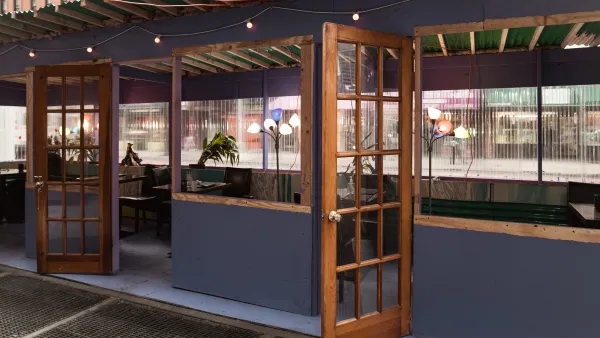
New York City Legalizes Outdoor Dining
Some restaurant owners worry the new requirements will make it too expensive to maintain outdoor dining structures.
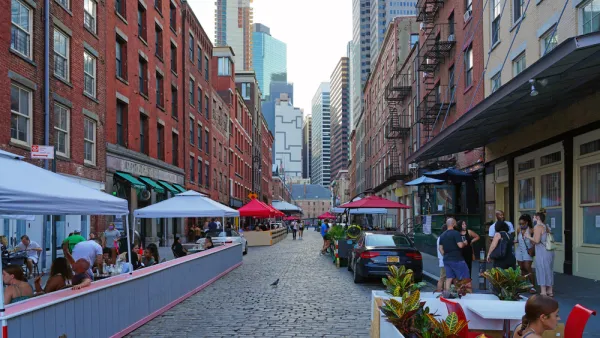
Open Streets and Outdoor Dining Are Best for Business, Report Says
Most business owners believe that they'd be out of business without on-street parking near their front door. The experience of New York City during the pandemic proves otherwise.
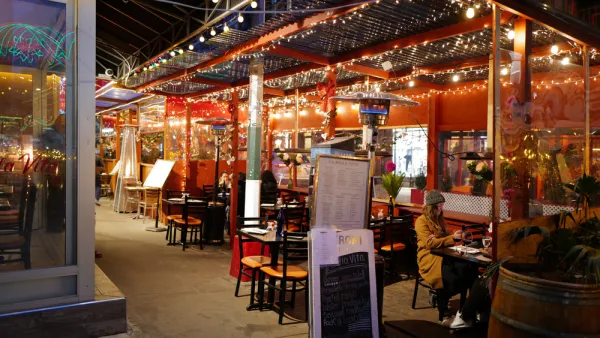
Who Should Manage New York’s Outdoor Dining Program?
A proposal to shift responsibility away from the Department of Transportation has met staunch resistance from industry groups and advocates of the program.

Planetizen Federal Action Tracker
A weekly monitor of how Trump’s orders and actions are impacting planners and planning in America.

California plans to bury El Niño’s downpour
If the state plays its cards right, it may be able to store a billion acre-feet of El Niño’s water in aquifers.

Chicago breaks ground on $3 billion megadevelopment
The new neighborhood, titled Foundry Park, will one day host 3,700 residences.

California High-Speed Rail Authority CEO resigns after $600,000 scandal
Under Ian Choudri, the authority used taxpayer dollars to fund first class flights and trips to nightclubs.

Want to study the Missouri River? Soon, you may need unanimous approval from 10 states
Legislation would require 10 governors’ permission to study or build projects moving water outside the basin.

Desperate measures: Advocates weigh draining Lake Powell to fill Colorado River
Draining the reservoir could reduce evaporation losses by a couple hundred thousand acre-feet.

FREE Course: Walkable City 1: Why Walkability?
After describing his path towards focusing on walkability as the essence of good planning, Jeff Speck marches through his five principal reasons for making more walkable places.
Reinventing Malls: Planning Alchemy—Turning Gray Fields Into Gold
The course focuses on the opportunities and imperatives that shape reinvention of mall sites.

City of Rosemead
Rutgers University, Edward J. Bloustein School of Planning and Public Policy
One Hundred Miles
Hunter College, City University of New York (CUNY)
The Architects Foundation
University of Cincinnati Online
City of Cambridge
Montrose County
The Pocatello Development Authority