New research by the Trust for Public Land explores connections between urban parks and health, building on prior research and offering insights such as the growing importance of partnerships with health organizations.



When you are feeling stressed or overwhelmed, you may want to spend some time at a park. Numerous studies have documented the physical and mental health benefits that parks offer. Adding to this literature, the Trust for Public Land (TPL) recently published a new report called “The Power of Parks to Promote Health” in conjunction with the release of its annual ranking of cities based on their park systems (ParkScore).
The report reveals that park systems are working in new ways with other organizations in communities to create programs and services focused on producing better health outcomes, including partnerships with health-care insurance companies and health-care providers. In fact, a majority of the 100 cities in the ParkScore rankings have a formal partnership with a health-care institution of some sort, and in a quarter of them, a health organization is providing funding or staff for health programs. Overall, TPL found over 800 examples of programs with targeted health outcomes.
TPL also shows that the better the park system, the greater the health benefits. On average, TPL reports that people living in cities in its top 25 are 21 percent less likely to be physically inactive and 9 percent less likely to have mental health problems than those in the bottom 25.
For details, please read the source article by Carl Smith.
Read the full story: Stressed, Overwhelmed, Out of Shape? There Is a Park for That

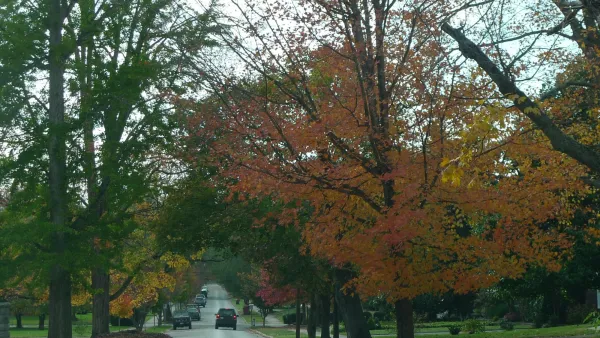
Research Shows Urban Trees Stave off Depression
A new study shows that regular exposure to trees and green spaces has a powerful impact on depression and mental health.
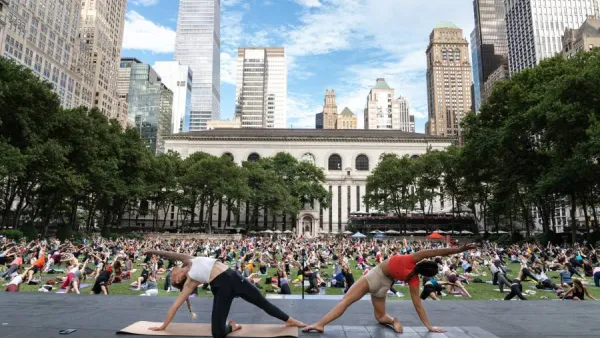
The Panacea of Outdoor Human Movement
Humans relish in over-complicating things, but the sweetest and healthiest things in life are the simplest.
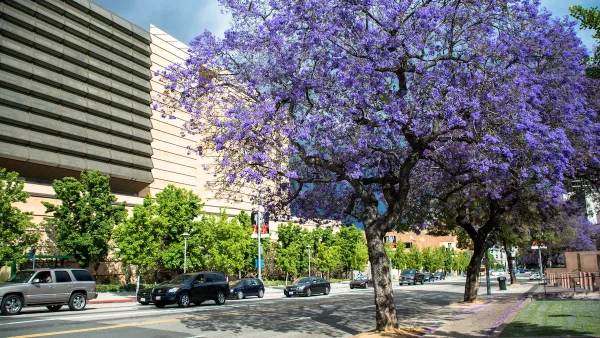
Addressing Tree Canopy Disparity in South Los Angeles
A new study highlights the complex challenge of addressing tree canopy disparities in South L.A., where historical environmental injustices, budget constraints, and competing community priorities hinder efforts to increase equitable tree coverage.

Planetizen Federal Action Tracker
A weekly monitor of how Trump’s orders and actions are impacting planners and planning in America.

The state-sanctioned urbicide of Austin
People don’t kill cities. Freeways do.

US to reduce Colorado River water deliveries to Mexico
A new Colorado Treaty amendment reduces Mexico’s Colorado River water allocation by 250,000 acre feet.

Nation's most wind-powered state turns to coal as data centers increase energy demand
For the first time in decades, Iowa has increased its generation of coal power.

NYC cools commuters with city's first rain garden above a bus stop
New York City officials say the plants in the rain garden can absorb 16 gallons of rainwater during heavy storms.

Brightline West’s future may rely on $6 billion federal loan
The company has until Nov. 2 to make a $400 million equity investment into its proposed high-speed rail line.

FREE Course: Walkable City 1: Why Walkability?
After describing his path towards focusing on walkability as the essence of good planning, Jeff Speck marches through his five principal reasons for making more walkable places.
Reinventing Malls: Planning Alchemy—Turning Gray Fields Into Gold
The course focuses on the opportunities and imperatives that shape reinvention of mall sites.

Eagle County Government
Harvard University Graduate School of Design
Nashville Planning Department
The Architects Foundation
University of Cincinnati Online
The Pocatello Development Authority
The Urban Renewal Agency of the City of Pocatello
Journal of the American Planning Association