The long-awaited east-west transit line is moving forward with support from a new governor, but still has a long road ahead.


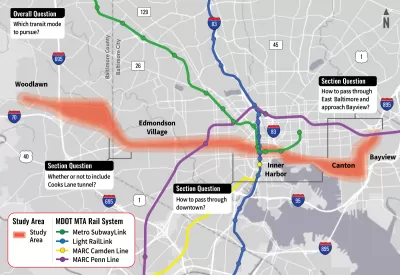
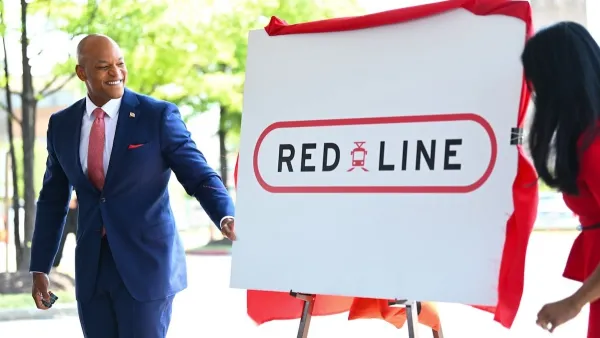
Last week, Maryland Governor Wes Moore announced the return of the Red Line to Baltimore, but the announcement left many logistical questions open, writes Alex Holt in Greater Greater Washington. “Which mode would a new Red Line take? Will it include tunnels when entering Baltimore City and passing through Downtown and Harbor East? How much will the project cost? How much of the original plans are still usable, when exactly construction will start, and how long it will take?”
The details released so far, Holt writes, “reinforce how monumental the Red Line’s return is to the future of Baltimore transit.” Holt notes that the route, while still in development, closely follows the original plan, and that heavy rail as an option looks “increasingly unlikely” due in part to the high cost. Meanwhile, bus rapid transit (BRT) is “a definite maybe” and would likely offer the most cost-effective and efficient option.
“The biggest next steps for the Red Line are (1) applying for entry next year into the federal Capital Investment Grants Program and (2) updating the project’s 2012 environmental impact statement (EIS) which was approved by the federal government in 2013.” In any case, the line won’t begin construction until at least 2026, but the MTA will begin testing Red Line-related improvements with a new bus pilot between the North Bend Loop and the Essex Park-and-Ride on August 27.
FULL STORY: Red Line redemption: What Governor Moore’s announcement means for Baltimore

Feds Pause Baltimore Red Line Permits
The MTA says it is committed to continuing work on the light rail project, but the pause signals a potential shift in federal funding for the east-west line.
Maryland Could Cut Transit Funding, Citing Budget Gap
The governor says the state remains committed to its major transit projects, but may need to reduce service to meet a growing financial shortfall.
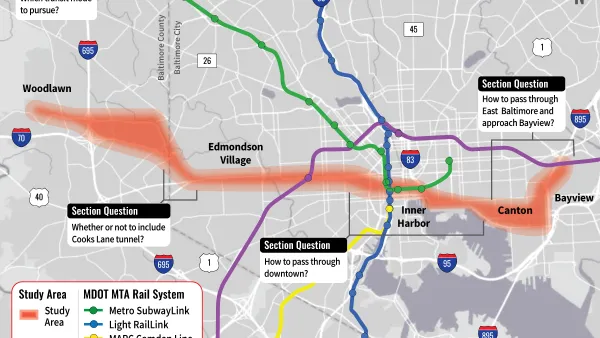
Maryland to Restart Planning for East-West Transit Line Through Baltimore
A plan for the Red Line, an east-west light rail line notoriously canceled by former-Governor Larry Hogan in 2015, is back on the table in Baltimore.

Planetizen Federal Action Tracker
A weekly monitor of how Trump’s orders and actions are impacting planners and planning in America.

The state-sanctioned urbicide of Austin
People don’t kill cities. Freeways do.

US to reduce Colorado River water deliveries to Mexico
A new Colorado Treaty amendment reduces Mexico’s Colorado River water allocation by 250,000 acre feet.

Mamdani overhauls NYC's Vision Zero plan with 100 new policy goals
The overhaul aims to reduce traffic deaths and make streets safer for pedestrians, cyclists and drivers through lower speed limits, new safety infrastructure and more.

Amtrak not solely to blame for New Jersey commuter rail's unreliability, report finds
A new study from the Garden State Initiative found that NJ Transit’s budget grew 20% across a 4 year period, but reliability declined significantly over the same period.

EPA erases limits on planet-warming pollution from power plants
Under Monday’s plan, power plants would still have some limits on how much mercury, arsenic and other contaminants they can emit.

FREE Course: Walkable City 1: Why Walkability?
After describing his path towards focusing on walkability as the essence of good planning, Jeff Speck marches through his five principal reasons for making more walkable places.
Reinventing Malls: Planning Alchemy—Turning Gray Fields Into Gold
The course focuses on the opportunities and imperatives that shape reinvention of mall sites.

Eagle County Government
Harvard University Graduate School of Design
Nashville Planning Department
The Architects Foundation
University of Cincinnati Online
The Pocatello Development Authority
The Urban Renewal Agency of the City of Pocatello
Journal of the American Planning Association