Local residents are calling for the redevelopment of a mostly abandoned 55-acre psychiatric hospital complex into affordable housing.


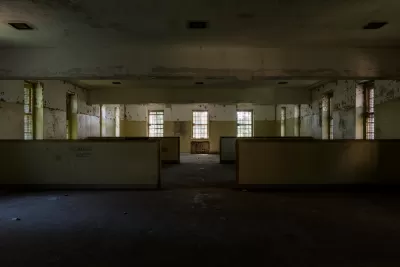
A defunct psychiatric hospital in Queens could provide 3,000 new affordable housing units, according to a coalition of local residents who are calling on New York to convert the state-owned Creedmoor Psychiatric Center property into a housing complex, write David Brand and Neil Mehta in Gothamist.
Queens Power Co-Chair Ben Thomases, who leads the nonprofit Queens Community House, said the state-owned land provides the perfect opportunity to build around 3,000 new income-restricted apartments, along with homes available to purchase, during a deepening housing crisis.
The complex could provide much-needed housing in the area. “The site is located in Queens Community District 13, where nearly half of low-income tenants spent at least 50% of their earnings on rent last year, an arrangement that leaves them “severely rent-burdened“ under federal guidelines, data from the Furman Center shows.”
The quasi-governmental Empire State Development agency says it is “continuing to seek input from local residents and community groups” to decide the site’s future. According to the article, “State officials will hold two public forums on the project next month as part of a planning process on what to do with the 55 acres south of the main hospital.”
Read the full story: Queens residents demand affordable housing on site of old psych hospital
Madison approves hundreds of affordable apartments as deadline for federal funding looms
A recently approved project will bring 163 affordable units to the north side.

LA approves $2B 'urban village' plan for former cold storage facilities
The project promises an interconnected neighborhood with a focus on public space.

Vacant downtown LA office building will be transformed into 512 affordable homes
The World Trade Center will create hundreds of new apartments with rents starting as low as $937.

Planetizen Federal Action Tracker
A weekly monitor of how Trump’s orders and actions are impacting planners and planning in America.

California plans to bury El Niño’s downpour
If the state plays its cards right, it may be able to store a billion acre-feet of El Niño’s water in aquifers.

Desperate measures: Advocates weigh draining Lake Powell to fill Colorado River
Draining the reservoir could reduce evaporation losses by a couple hundred thousand acre-feet.

Mamdani’s pied-à-terre tax survives legal challenge
A panel of judges found that the plaintiffs failed to demonstrate injury as a result of New York City's implementation of the tax.

Eastern Nebraska is running out of electricity
Data centers and electrification are straining eastern Nebraska’s grid, throttling economic development.

Seattle passes record-breaking transit services expansion
Proposition 1 will double the city’s transit tax to add 95,000 more bus trips and preserve 180,000 bus trips annually.

FREE Course: Walkable City 1: Why Walkability?
After describing his path towards focusing on walkability as the essence of good planning, Jeff Speck marches through his five principal reasons for making more walkable places.
Reinventing Malls: Planning Alchemy—Turning Gray Fields Into Gold
The course focuses on the opportunities and imperatives that shape reinvention of mall sites.

City of Rosemead
Rutgers University, Edward J. Bloustein School of Planning and Public Policy
One Hundred Miles
University of Michigan School for Environment and Sustainability (SEAS)
Hunter College, City University of New York (CUNY)
The Architects Foundation
City of Cambridge
Montrose County
The Pocatello Development Authority