The Alexandria-to-Mount Vernon corridor has one of the highest crash rates on the roadway.


The Virginia Department of Transportation will reduce the speed limit on a seven-mile segment of Richmond Highway, a corridor particularly dangerous to pedestrians and bicyclists that sees roughly 47,000 vehicles per day.
According to Emily Leayman in Greater Alexandria Patch, the speed limit will change from 45 mph to 35 mph between Alexandria and Mount Vernon starting May 23.
State Senator Scott Surovell praised the move, saying “This will save lives and reduce injuries given the increased traffic volumes and multimodal needs the road was never designed to handle.”
Read the full story: Richmond Highway Speed Limit To Be Reduced To 35 Mph Over 7 Miles

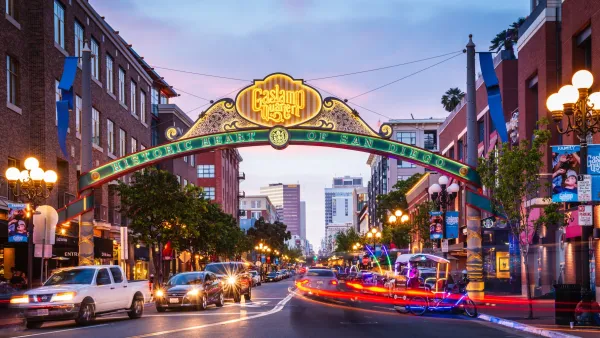
San Diego to Lower Speed Limits on 20% of its Streets
The city council approved reduced speed limits on streets designated as high-risk corridors, school zones, and other areas as part of its Vision Zero strategy.
San Diego to Lower Speed Limits on 11 Streets
A 2022 state law allows cities to reduce speed limits for safety reasons rather than relying on average traffic speeds to dictate speed limits.

Savannah Reduces Speed Limits on Almost 100 City Streets
The historic Georgia city is lowering speed limits in an effort to reduce road fatalities.

Planetizen Federal Action Tracker
A weekly monitor of how Trump’s orders and actions are impacting planners and planning in America.

California plans to bury El Niño’s downpour
If the state plays its cards right, it may be able to store a billion acre-feet of El Niño’s water in aquifers.

Chicago breaks ground on $3 billion megadevelopment
The new neighborhood, titled Foundry Park, will one day host 3,700 residences.

California High-Speed Rail Authority CEO resigns after $600,000 scandal
Under Ian Choudri, the authority used taxpayer dollars to fund first class flights and trips to nightclubs.

Want to study the Missouri River? Soon, you may need unanimous approval from 10 states
Legislation would require 10 governors’ permission to study or build projects moving water outside the basin.

Desperate measures: Advocates weigh draining Lake Powell to fill Colorado River
Draining the reservoir could reduce evaporation losses by a couple hundred thousand acre-feet.

FREE Course: Walkable City 1: Why Walkability?
After describing his path towards focusing on walkability as the essence of good planning, Jeff Speck marches through his five principal reasons for making more walkable places.
Reinventing Malls: Planning Alchemy—Turning Gray Fields Into Gold
The course focuses on the opportunities and imperatives that shape reinvention of mall sites.

City of Rosemead
Rutgers University, Edward J. Bloustein School of Planning and Public Policy
One Hundred Miles
Hunter College, City University of New York (CUNY)
The Architects Foundation
University of Cincinnati Online
City of Cambridge
Montrose County
The Pocatello Development Authority