Mayor London Breed’s newest proposal for revitalizing downtown San Francisco faces some sharp criticism for offering no new solutions after the city failed to deliver on goals and recommendations made in 2020.


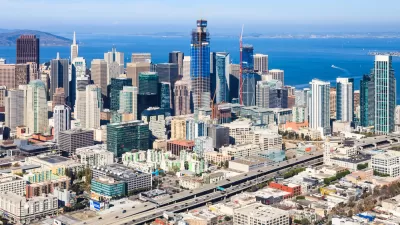
Writing in Mission Local, Joe Eskenazi critiques the city of San Francisco’s new “Roadmap for Downtown San Francisco’s Future,” a plan aimed at revitalizing the city’s faltering downtown and reorienting it to a post-Covid future.
In Eskenazi’s view, “The Roadmap is a set of goals, and a spiffy website. But the new plan is neither new, nor a plan.” Three of Mayor London Breed’s most well-publicized proposals—“simplifying and speeding up permitting; allowing developers to defer paying impact fees; and expediting the transformation of office buildings into residential”—are nothing new, Eskenazi writes, but draw on similar proposals from a report assembled in 2020.
Unlike other cities, San Francisco didn’t actively work to attract its top new industry, tech. Thanks to a combination of factors, the industry grew up in the Bay Area, claiming many of San Francisco’s downtown office buildings. “So it remains to be seen if San Francisco’s government can artificially re-create the success it didn’t initially create,” Eskenazi believes, despite Mayor Breed’s attempt to position AI and biotech as the future of the city—prospects Eskenazi finds unlikely. Eskenazi points to poverty and crime, as well as the “devastation” of the city’s transit services, as major contributors to the central city’s decline. The article quotes David Prowler, former Director of the Mayor’s Office of Economic Development: “Keeping the streets clean and safe ‘is the normal job of government. That should not be triggered by a crisis,’” Prowler said. “These are the things government should be able to do.”
FULL STORY: Mayor’s new downtown plan is neither new, nor a plan


Office conversion is picking up steam in San Francisco
The city spent five years streamlining approval processes and reducing fees to encourage more adaptive reuse of vacant office buildings.

With Zero Office Conversions in Four Years, San Francisco Pins Hopes on New Special Financing District
City leaders hope the new incentive will spur the redevelopment of some of the city’s 30,000 square feet of vacant office space into housing.
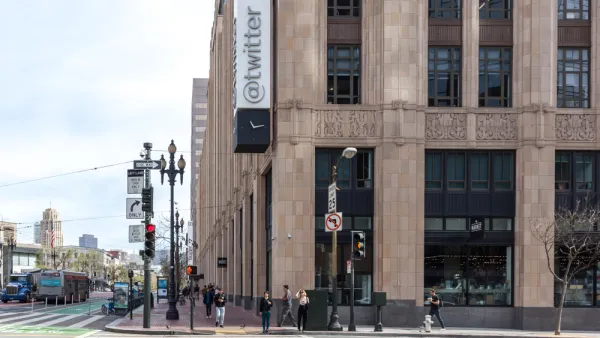
City Requiring Permits for Twitter’s Dystopian Office Bedrooms
After a Forbes article revealed dozens of makeshift sleeping areas in Twitter’s downtown San Francisco offices, the city is asking the company to file for permits if they want to keep them.

Planetizen Federal Action Tracker
A weekly monitor of how Trump’s orders and actions are impacting planners and planning in America.

The state-sanctioned urbicide of Austin
People don’t kill cities. Freeways do.

US to reduce Colorado River water deliveries to Mexico
A new Colorado Treaty amendment reduces Mexico’s Colorado River water allocation by 250,000 acre feet.

Brightline West’s future may rely on $6 billion federal loan
The company has until Nov. 2 to make a $400 million equity investment into its proposed high-speed rail line.

LA Metro’s ultimatum: no extra buses for LA28 if federal funding isn’t imminently secured
If Metro does not provide additional buses, LA28 organizers will have to find a new way to manage Olympic traffic. LA28’s budget does not include a line item for transit.

Colorado’s Largest Data Center Could Rise Next to Homes — Without a Public Hearing
The proposed campus would consume 11 times the power of Denver International Airport; as it has across the country, opposition mounts.

FREE Course: Walkable City 1: Why Walkability?
After describing his path towards focusing on walkability as the essence of good planning, Jeff Speck marches through his five principal reasons for making more walkable places.
Reinventing Malls: Planning Alchemy—Turning Gray Fields Into Gold
The course focuses on the opportunities and imperatives that shape reinvention of mall sites.

Eagle County Government
Harvard University Graduate School of Design
Nashville Planning Department
The Architects Foundation
University of Cincinnati Online
The Pocatello Development Authority
The Urban Renewal Agency of the City of Pocatello
Journal of the American Planning Association