The U.S. National Blueprint for Transportation Decarbonization is designed to guide federal investment and regulations, focusing on electrification with a nod to transit investment and walkability.



A ‘first of its kind’ federal plan sets out goals for cutting carbon emissions in the transportation sector, but postpones the biggest reductions to the 2030s and 2040s, according to an article by Ian Duncan in the Washington Post. “The blueprint doesn’t set out new, enforceable targets, but serves as a long-term guide for federal agencies tasked with writing climate rules and spending environmental funds,” Duncan explains.
The plan is based on three concepts: ‘convenient,’ which includes promoting more walkable communities; ‘efficient,’ including modes of transportation like buses and trains; and ‘clean,’ for fuels like batteries and hydrogen.
The plan relies on the adoption of electric vehicles for most of the reductions. As Duncan notes, “The infrastructure law included $7.5 billion for charging infrastructure, split between a network along highways that officials hope will give drivers confidence to take electric vehicles on long road trips, and a program designed to ensure that disadvantaged communities have access to chargers.” The law also includes a $7,500 electric vehicle tax credit (though it notably excludes credits for electric bikes). However, Duncan points out that “Electric vehicles accounted for less than 1 percent of miles driven in 2021 in the United States,” and the growing popularity of large trucks and SUVs is slowing any gains in emissions reduction.
Meanwhile, “many environmental advocates have urged state transportation agencies to limit the construction of new highways that tend to encourage driving, and instead invest money in alternative infrastructure, such as bus lanes and bike paths.” According to a Georgetown Climate Center study, “if money from the infrastructure law were invested in such green projects, it could contribute a further percentage point cut to emissions over the course of the decade.”
For more information, also see a U.S. Department of Transportation press release announcing the U.S. National Blueprint for Transportation Decarbonization. The blueprint is also available online at the U.S. Department of Energy website.
FULL STORY: Biden administration plan seeks elimination of transportation emissions

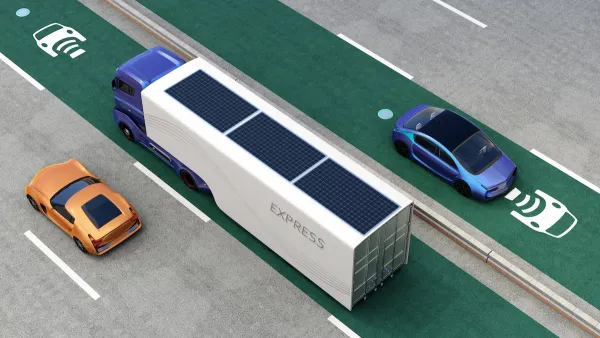
UCLA Will Build California’s First EV Charging Roadway
The ¾-mile segment will allow electric shuttles and buses to charge while driving.
USDOT Unveils Strategies to Achieve Near-Zero Transportation Emissions
Three key strategies — reducing travel distances, increasing energy-efficient travel modes, and transitioning to zero-emission vehicles and fuels — are recommended to meet national climate goals under the Paris Agreement.
Study: D.C. Region Must Take Aggressive Steps To Reach Climate Goal
To achieve its stated emissions reduction goal, the Greater Washington area must sharply reduce driving and speed up the adoption of electric vehicles.

Planetizen Federal Action Tracker
A weekly monitor of how Trump’s orders and actions are impacting planners and planning in America.

The state-sanctioned urbicide of Austin
People don’t kill cities. Freeways do.

US to reduce Colorado River water deliveries to Mexico
A new Colorado Treaty amendment reduces Mexico’s Colorado River water allocation by 250,000 acre feet.

Mamdani overhauls NYC's Vision Zero plan with 100 new policy goals
The overhaul aims to reduce traffic deaths and make streets safer for pedestrians, cyclists and drivers through lower speed limits, new safety infrastructure and more.

Amtrak not solely to blame for New Jersey commuter rail's unreliability, report finds
A new study from the Garden State Initiative found that NJ Transit’s budget grew 20% across a 4 year period, but reliability declined significantly over the same period.

EPA erases limits on planet-warming pollution from power plants
Under Monday’s plan, power plants would still have some limits on how much mercury, arsenic and other contaminants they can emit.

FREE Course: Walkable City 1: Why Walkability?
After describing his path towards focusing on walkability as the essence of good planning, Jeff Speck marches through his five principal reasons for making more walkable places.
Reinventing Malls: Planning Alchemy—Turning Gray Fields Into Gold
The course focuses on the opportunities and imperatives that shape reinvention of mall sites.

Eagle County Government
Harvard University Graduate School of Design
Nashville Planning Department
The Architects Foundation
University of Cincinnati Online
The Pocatello Development Authority
The Urban Renewal Agency of the City of Pocatello
Journal of the American Planning Association