The cities that are making their pandemic-era car-free experiments permanent.


While some cities are reverting their ‘open streets’ to car-oriented spaces, others are keeping the car-free spaces created during the pandemic. An article by Linda Poon, Feargus O'Sullivan, and Amy Yee in Bloomberg CityLab highlights the places where street transformations are becoming part of the permanent fabric of the city.
The list includes San Francisco’s John F. Kennedy Drive, a mile of which winds through Golden Gate Park. After the city banned cars on this stretch in 2020, local groups mounted an intense opposition campaign. “It has since turned into a full-out pedestrian promenade, with vibrant street murals and eye-popping art installations, including a trio of seven-foot-tall dachshund head sculptures from the city’s defunct fast-food icon Doggie Diner, planted right in the middle of the street.” Ultimately, the city decided to keep the road car-free.
Another success story is 34th Avenue in Jackson Heights, Queens, which became a vibrant pedestrian hub as part of the city’s Open Streets initiative. While there is some local opposition, the street has so far remained car-free.
The article also describes projects in Stockholm, Paris, Milan, Bogotá, and Quito, where a 1-mile segment of Viracocha Street was made safer for pedestrians and cyclists with extended sidewalks, new crosswalks, narrowed traffic lanes, and a street mural.
FULL STORY: The Cities Keeping Their Car-Free Spaces

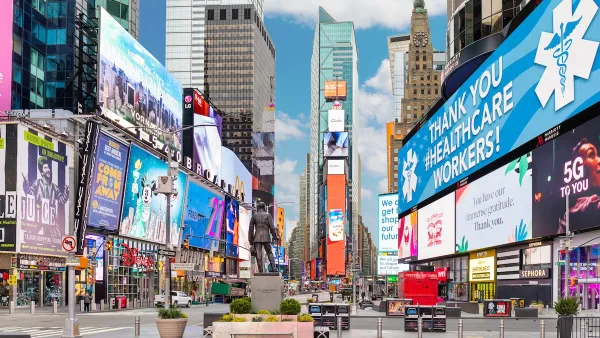
NYC Officials Announce Broadway Pedestrianization Project
Two blocks of the marquee street will become mostly car-free public spaces.
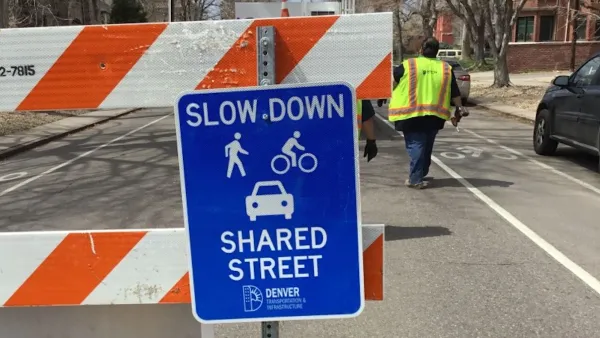
Denver Plans to Make Some Open Streets Permanent
The city is moving to institutionalize segments of streets that were successfully pedestrianized during the pandemic.
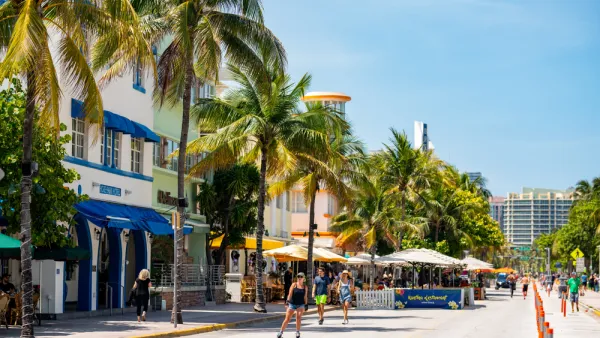
Miami Beach to Reopen Ocean Drive to Cars
The famous cruising strip was off-limits to cars during the pandemic. Now, the city is letting vehicles return with some pedestrian-oriented compromises.

Planetizen Federal Action Tracker
A weekly monitor of how Trump’s orders and actions are impacting planners and planning in America.

The state-sanctioned urbicide of Austin
People don’t kill cities. Freeways do.

US to reduce Colorado River water deliveries to Mexico
A new Colorado Treaty amendment reduces Mexico’s Colorado River water allocation by 250,000 acre feet.

Mamdani overhauls NYC's Vision Zero plan with 100 new policy goals
The overhaul aims to reduce traffic deaths and make streets safer for pedestrians, cyclists and drivers through lower speed limits, new safety infrastructure and more.

Amtrak not solely to blame for New Jersey commuter rail's unreliability, report finds
A new study from the Garden State Initiative found that NJ Transit’s budget grew 20% across a 4 year period, but reliability declined significantly over the same period.

EPA erases limits on planet-warming pollution from power plants
Under Monday’s plan, power plants would still have some limits on how much mercury, arsenic and other contaminants they can emit.

FREE Course: Walkable City 1: Why Walkability?
After describing his path towards focusing on walkability as the essence of good planning, Jeff Speck marches through his five principal reasons for making more walkable places.
Reinventing Malls: Planning Alchemy—Turning Gray Fields Into Gold
The course focuses on the opportunities and imperatives that shape reinvention of mall sites.

Eagle County Government
Harvard University Graduate School of Design
Nashville Planning Department
The Architects Foundation
University of Cincinnati Online
The Pocatello Development Authority
The Urban Renewal Agency of the City of Pocatello
Journal of the American Planning Association