The agency wants to upgrade infrastructure and fix ‘long-standing deficiencies’ in its Chicago-area operations.


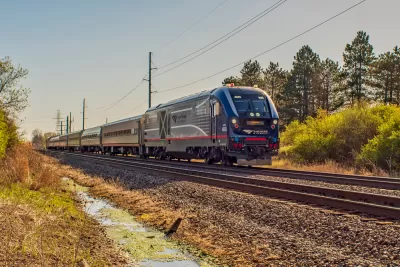
Reporting for Trains.com, Bob Johnston outlines Amtrak’s proposed plan to upgrade its Chicago-area infrastructure. “Amtrak is seeking more than $200 million in federal funding, along with money from state and local sources, in an attempt to fix a series of long-standing deficiencies, capacity limitations, and how trains from the south and east enter Chicago.”
Johnston lists the projects that would be funded under this request, including: direct access from the St. Charles Airline to Chicago Union Station to eliminate a time-consuming maneuver that some trains are currently forced to make, “property acquisition for storage and displaced service functions,” and the ‘reactivation’ of Chicago’s Union Station mail platform, among other interconnected projects. Some of the projects are speculative, such as a proposal to acquire Canadian National’s Lakefront Line.
Read the full story: Amtrak unveils infrastructure plan to transform Chicago operations

The Subversive Car-Free Guide to Trump's Great American Road Trip
Car-free ways to access Chicagoland’s best tourist attractions.
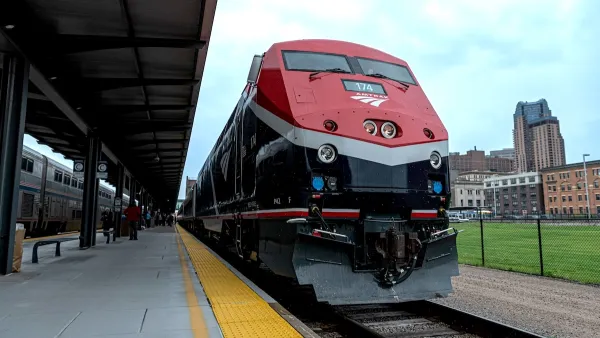
Amtrak’s Borealis Exceeds First Year Ridership Expectations
205,800 passengers have boarded the St. Paul to Chicago line, well above initial MDOT projections.
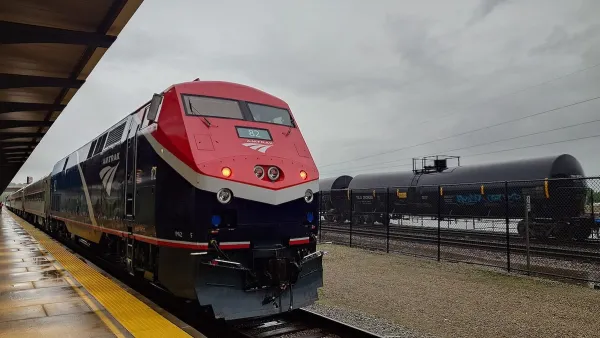
Amtrak Borealis Line Celebrates 100,000 Passengers
The St. Paul-to-Chicago train served more than 22,000 passengers in August.

Planetizen Federal Action Tracker
A weekly monitor of how Trump’s orders and actions are impacting planners and planning in America.

California plans to bury El Niño’s downpour
If the state plays its cards right, it may be able to store a billion acre-feet of El Niño’s water in aquifers.

Desperate measures: Advocates weigh draining Lake Powell to fill Colorado River
Draining the reservoir could reduce evaporation losses by a couple hundred thousand acre-feet.

Mamdani’s pied-à-terre tax survives legal challenge
A panel of judges found that the plaintiffs failed to demonstrate injury as a result of New York City's implementation of the tax.

Eastern Nebraska is running out of electricity
Data centers and electrification are straining eastern Nebraska’s grid, throttling economic development.

Seattle passes record-breaking transit services expansion
Proposition 1 will double the city’s transit tax to add 95,000 more bus trips and preserve 180,000 bus trips annually.

FREE Course: Walkable City 1: Why Walkability?
After describing his path towards focusing on walkability as the essence of good planning, Jeff Speck marches through his five principal reasons for making more walkable places.
Reinventing Malls: Planning Alchemy—Turning Gray Fields Into Gold
The course focuses on the opportunities and imperatives that shape reinvention of mall sites.

City of Rosemead
Rutgers University, Edward J. Bloustein School of Planning and Public Policy
One Hundred Miles
University of Michigan School for Environment and Sustainability (SEAS)
Hunter College, City University of New York (CUNY)
The Architects Foundation
City of Cambridge
Montrose County
The Pocatello Development Authority