Oregon, the first state to end single-family zoning statewide, is on the cusp of another historic planning reform as the Land Conservation and Development Commission nears approval for new “Climate-Friendly and Equitable Communities” rules.



[Updated on July 9, 2022 to correct the number of jurisdictions affected by the statewide reform from 61 to 52.]
Oregon’s Land Conservation and Development Commission is in the process of approving a major reform package of land use regulations that would give 52 cities in the state options for rolling back parking regulations.
The commission granted preliminary approval to the Climate-Friendly and Equitable Communities rules in May, with a hearing to fully approve the rules scheduled for July.
News coverage of the commission’s decision includes a guest column by James Roberts for the Bulletin, which focuses on the impact of the new rules specifically for the city of Bend. Roberts, a resident of the city of Bend, has clearly read The High Cost of Free Parking, describing parking regulations at arbitrarily established. “Today in Bend, our zoning rules require nearly all new homes to build at least one or two off-street parking spaces, even though half of households who rent only own one or zero cars. Those extra spots that go unused aren’t just a waste of space, they also add building costs to already high rents,” writes Roberts.
Coverage of the decision also includes a series of articles published by the Sightline Institute. A May 21 Sightline article by Michael Andersen reports on how close the commission is to approving the sweeping parking reforms, with details about the politics of the parking issue at the state level.
An earlier Sightline article by Andersen along with Catie Gould details the reach and intent of the Climate-Friendly and Equitable Communities rules.
“Over the next three years, it would give the 52 jurisdictions in the state’s eight largest metro areas—the urbanized areas in and around Albany, Bend, Corvallis, Eugene, Grants Pass, Medford, Portland, and Salem, home to about two-thirds of the state’s population—various options for rolling back or eliminating their decades-old parking mandates, especially in designated ‘climate-friendly areas’ (CFAs). The CFAs, whose borders would be drawn by most of the jurisdictions over the next few years, would also allow mixed-use buildings of up to four stories and see higher standards for walking, biking, and transit investments,” according to the article.
FULL STORY: OREGON NEARS GREEN LIGHT FOR BIG PARKING REFORM


Cities Plan to Sue Over Oregon’s Parking Reforms
Nine of the 52 cities impacted by the state of Oregon’s parking requirements changes, approved earlier this year, plan to sue to stop the reforms.
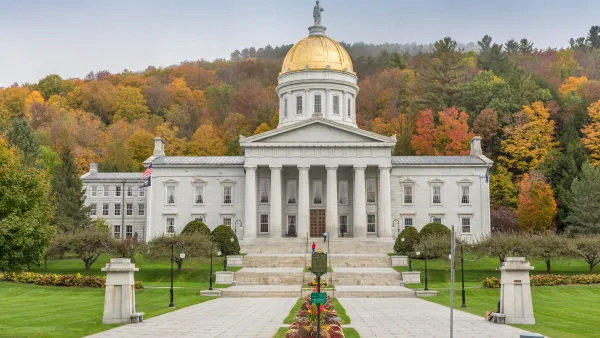
Vermont Next State in Line to End Single-Family Zoning, Ease Parking Requirements
Both houses in the Vermont Legislature have approved legislation to preempt local land use regulations by rescinding single-family zoning and easing parking requirements throughout the state.
Oregon Makes Historic Parking Reforms. What’s Next?
The state made sweeping reforms that eliminate parking requirements in some jurisdictions, which supporters hope will lead to faster, less expensive construction and the revitalization of vacant properties and underused lots.

Planetizen Federal Action Tracker
A weekly monitor of how Trump’s orders and actions are impacting planners and planning in America.

The state-sanctioned urbicide of Austin
People don’t kill cities. Freeways do.

US to reduce Colorado River water deliveries to Mexico
A new Colorado Treaty amendment reduces Mexico’s Colorado River water allocation by 250,000 acre feet.

Mamdani overhauls NYC's Vision Zero plan with 100 new policy goals
The overhaul aims to reduce traffic deaths and make streets safer for pedestrians, cyclists and drivers through lower speed limits, new safety infrastructure and more.

Amtrak not solely to blame for New Jersey commuter rail's unreliability, report finds
A new study from the Garden State Initiative found that NJ Transit’s budget grew 20% across a 4 year period, but reliability declined significantly over the same period.

EPA erases limits on planet-warming pollution from power plants
Under Monday’s plan, power plants would still have some limits on how much mercury, arsenic and other contaminants they can emit.

FREE Course: Walkable City 1: Why Walkability?
After describing his path towards focusing on walkability as the essence of good planning, Jeff Speck marches through his five principal reasons for making more walkable places.
Reinventing Malls: Planning Alchemy—Turning Gray Fields Into Gold
The course focuses on the opportunities and imperatives that shape reinvention of mall sites.

Eagle County Government
Harvard University Graduate School of Design
Nashville Planning Department
The Architects Foundation
University of Cincinnati Online
The Pocatello Development Authority
The Urban Renewal Agency of the City of Pocatello
Journal of the American Planning Association