The NFL draft shut down the Las Vegas Strip to car traffic. Some people liked the change so much that a new law proposes to permanently block cars from the street. Yes, you read that correctly.


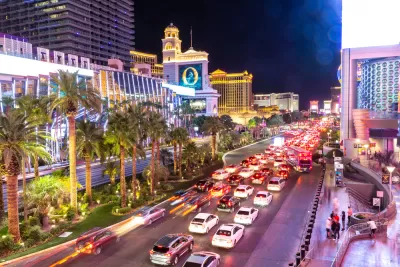
Clark County Commissioner Tick Segerblom is following the lead of the National Football League and proposing a law that would permanently block cars from Las Vegas Boulevard where it passes through the unincorporated part of Clark County known, famously, as the Las Vegas Strip. Commissioner announced the proposed law in a Tweet on April 28.
The National Football League recently shut down the street as part of the festivities surrounding the 2022 Draft. The draft isn’t the only precedent for car-free streets in Las Vegas—Fremont Street in Downtown Las Vegas (in the actual city of Las Vegas) has been car-free since 1994.
Multiple Fox affiliates picked up the news of the proposed Strip closure, including Fox11 in Los Angeles and Fox5 in Las Vegas. Both articles are short on the details of the proposed law that would close the Las Vegas strip to automobile traffic.
Anyone who has been to Las Vegas knows that the strip is infamously hostile to pedestrians. Las Vegas Boulevard is wide, unsafe for pedestrians and vehicles alike, and oppressively congested. Moreover, the surrounding built environment is designed to keep visitors inside, spending money. The Las Vegas Strip is also the most visited tourist location in the world. A car-free Strip would be perhaps the most complete (symbolic) setback for the car-centric planning status after several years of changes in the public realm.
Read the full story: Bill would permanently ban vehicle traffic on Las Vegas Strip
Open Street Abandoned in New York
The New York Department of Transportation is changing the way it plans and manages open streets as political support for the concept wavers.
Las Vegas is building its first protected bike lane
The new lane connects Henderson and the Las Vegas Raiders headquarters via Starr Avenue.
Nevada is no Longer a Haven of Housing Affordability
Large investors own 11 percent of single-family rentals in Las Vegas — far above the national average of 3 percent.

Planetizen Federal Action Tracker
A weekly monitor of how Trump’s orders and actions are impacting planners and planning in America.

California plans to bury El Niño’s downpour
If the state plays its cards right, it may be able to store a billion acre-feet of El Niño’s water in aquifers.

Desperate measures: Advocates weigh draining Lake Powell to fill Colorado River
Draining the reservoir could reduce evaporation losses by a couple hundred thousand acre-feet.

In Texas, data centers are swallowing promised parkland
Residents who moved to Taylor, Texas for a rural community now have to contend with three data centers in their backyard.

How a Chicago-sized wind farm beat the odds and powered on
The project spanned five presidential administrations and a standoff with a U.S. military base.

MTA gives itself 30 days to transform pit into basketball court
The site has been under construction since 2022; the city originally estimated it would finish the court in 2024.

FREE Course: Walkable City 1: Why Walkability?
After describing his path towards focusing on walkability as the essence of good planning, Jeff Speck marches through his five principal reasons for making more walkable places.
Reinventing Malls: Planning Alchemy—Turning Gray Fields Into Gold
The course focuses on the opportunities and imperatives that shape reinvention of mall sites.

City of Rosemead
Rutgers University, Edward J. Bloustein School of Planning and Public Policy
One Hundred Miles
Hunter College, City University of New York (CUNY)
The Architects Foundation
University of Cincinnati Online
City of Cambridge
Montrose County
The Pocatello Development Authority