Thanks to longer fire seasons and increasingly intense blazes, Western states are experiencing the nation’s worst air quality.


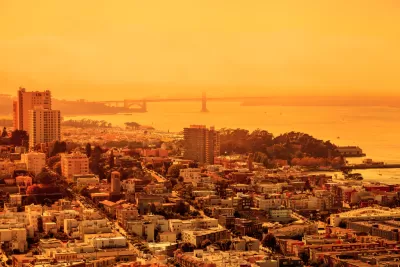
Kylie Mohr describes the findings of a report from the American Lung Association that assesses air quality around the United States. “Its “State of the Air” analysis looks at two of the six outdoor air pollutants regulated by the Clean Air Act, including both short-term spikes and annual levels of particle pollution, and ground-level ozone air pollution, often known as smog.”
According to the report, “More days with ‘very unhealthy’ and ‘hazardous’ air quality were documented than ever before recorded in the report’s 20-year existence.”
Altogether, almost 9 million more people were exposed to unhealthy levels of particulate pollution compared to previous reports, in large part due to breathing in wildfire smoke.
Mohr explains, “Emissions from transportation and power plants have fallen drastically since the implementation of the 1970 Clean Air Act, a comprehensive federal law that regulates sources of emissions. But in recent years, climate change-fueled increases in pollution are increasing public health challenges.” Consequently, “The urban, industrialized Eastern and Midwestern states are now getting passing grades compared to 15 years ago, while Western states now dominate the charts.”
Air pollution doesn’t affect everyone in the same way. “The report also reiterates the fact that socioeconomic inequalities exacerbate environmental harms. People of color were 61% more likely than white people to live in a county failing in at least one pollutant category, and over three times as likely to live in a county with a failing grade for all three kinds of pollution.”
To improve these conditions, “The American Lung Association would like to see the EPA strengthen its air-quality standards for particulate matter and ozone as a first step.” The article acknowledges that “While that won’t begin to eliminate the particulate matter coming from the West’s increasingly severe wildfires, or wholly mitigate the climate’s impact on ozone pollution, actions from the individual to federal level could help move the needle toward a vision of clear valleys, cityscapes and sunsets.”
Read the full story: Air quality report card flunks the West

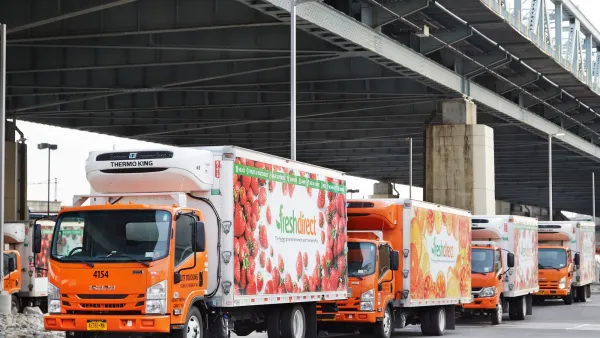
NYC Congestion Pricing Revenue Will Fund up to 1,000 Hybrid Refrigerated Trucks
Traffic to the Hunts Point Produce Market causes increased rates of asthma in surrounding neighborhoods.
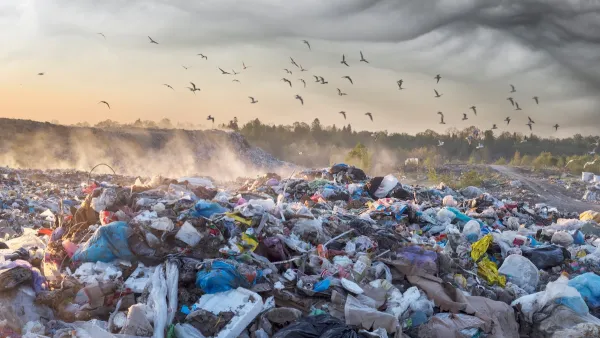
Colorado Landfills Emit as Much Pollution as 1M Cars
Landfills are the third-largest source of methane pollution in Colorado, after agriculture and fossil fuel extraction.

Driving Equity and Clean Air: California Invests in Greener School Transportation
California has awarded $500 million to fund 1,000 zero-emission school buses and chargers for educational agencies as part of its effort to reduce pollution, improve student health, and accelerate the transition to clean transportation.

Planetizen Federal Action Tracker
A weekly monitor of how Trump’s orders and actions are impacting planners and planning in America.

California plans to bury El Niño’s downpour
If the state plays its cards right, it may be able to store a billion acre-feet of El Niño’s water in aquifers.

Desperate measures: Advocates weigh draining Lake Powell to fill Colorado River
Draining the reservoir could reduce evaporation losses by a couple hundred thousand acre-feet.

In Texas, data centers are swallowing promised parkland
Residents who moved to Taylor, Texas for a rural community now have to contend with three data centers in their backyard.

How a Chicago-sized wind farm beat the odds and powered on
The project spanned five presidential administrations and a standoff with a U.S. military base.

MTA gives itself 30 days to transform pit into basketball court
The site has been under construction since 2022; the city originally estimated it would finish the court in 2024.

FREE Course: Walkable City 1: Why Walkability?
After describing his path towards focusing on walkability as the essence of good planning, Jeff Speck marches through his five principal reasons for making more walkable places.
Reinventing Malls: Planning Alchemy—Turning Gray Fields Into Gold
The course focuses on the opportunities and imperatives that shape reinvention of mall sites.

City of Rosemead
Rutgers University, Edward J. Bloustein School of Planning and Public Policy
One Hundred Miles
Hunter College, City University of New York (CUNY)
The Architects Foundation
University of Cincinnati Online
City of Cambridge
Montrose County
The Pocatello Development Authority