The mass timber construction, proximity to transit, and bike room make a proposed Toronto building a model for post-pandemic offices.


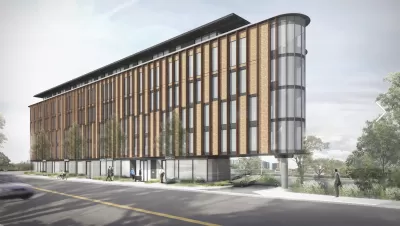
An office building known as the Leaside Innovation Center (LIC) planned for Toronto's Leaside neighborhood could serve as a model for efficient and sustainable architecture, writes Lloyd Alter in Treehugger. The building, "developed by Charles Goldsmith, designed by Greg Latimer of Studio CANOO, and engineered by David Moses," is constructed from mass timber, which lowers its carbon footprint and reduces the weight load on the foundation. "Unusually, the Leaside Innovation Centre is clad in prefabricated thin brick panels with only a 40% glass-to-wall ratio. They note this allows for much more insulation, reducing the size of the mechanical systems."
"The LIC is a five-minute walk to a new transit line and is surrounded by very expensive homes in desirable residential areas. Basically, it's what could be ground zero in a Leaside 15-minute city, and may well attract tenants and buyers from the immediate area." The building will also feature 30 bike parking spaces and two showers.
According to Alter, "If people are going to get dragged back to the office, this is where they will want to go—close to home, lots of light and fresh well-filtered air, a little biophilic goodness from all the wood, nice amenities, and a glorious bike locker."
Read the full story: This Toronto Building Is a Model for a Post-Pandemic Office

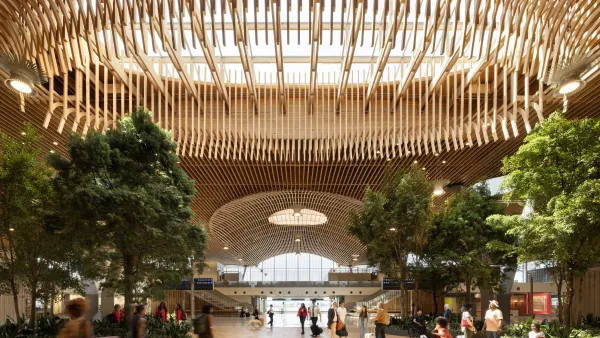
PDX International Airport’s New Terminal Is a Mass-Timber Marvel
Needing to expand to accommodate 35 million annual passengers by 2045 but constrained by Portland’s urban growth boundary, PDX had to think outside the box when planning its expansion. The result is a case study in sustainability.

Expanding the Concept of Transit-Oriented Development: Lessons from Abroad
Keeping transit planning and development siloed can limit opportunities to build affordable housing and vibrant neighborhoods.
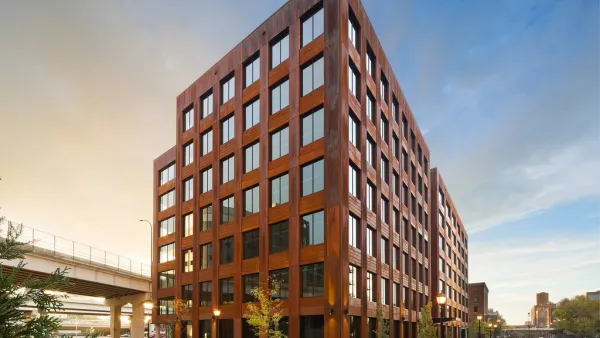
It’s Time to Ditch the Concrete and Steel. Wood Is the Construction Material of the Future
A move toward wooden buildings would lead to a host of positive environmental, economic, and livability outcomes.

Planetizen Federal Action Tracker
A weekly monitor of how Trump’s orders and actions are impacting planners and planning in America.

California plans to bury El Niño’s downpour
If the state plays its cards right, it may be able to store a billion acre-feet of El Niño’s water in aquifers.

Chicago breaks ground on $3 billion megadevelopment
The new neighborhood, titled Foundry Park, will one day host 3,700 residences.

Move over, LA: St. Louis gears up for Olympics, invests millions in downtown redevelopment
The Missouri city will host the 2028 Olympic soccer group stage and knockout matches.

Satanic place names
From streams and lakes to valleys and canyons, I mapped more than 1,000 places named after the Devil.

California High-Speed Rail Authority CEO resigns after $600,000 scandal
Under Ian Choudri, the authority used taxpayer dollars to fund first class flights and trips to nightclubs.

FREE Course: Walkable City 1: Why Walkability?
After describing his path towards focusing on walkability as the essence of good planning, Jeff Speck marches through his five principal reasons for making more walkable places.
Reinventing Malls: Planning Alchemy—Turning Gray Fields Into Gold
The course focuses on the opportunities and imperatives that shape reinvention of mall sites.

City of Rosemead
Rutgers University, Edward J. Bloustein School of Planning and Public Policy
One Hundred Miles
Hunter College, City University of New York (CUNY)
The Architects Foundation
University of Cincinnati Online
City of Cambridge
Montrose County
The Pocatello Development Authority