The Dallas region is the latest to update its transit system on a high-frequency grid with on-demand transit service to fill in the gaps.



Alanna Quillen and Ken Kalthoff report for NBC DFW that Dallas Area Rapid Transit (DART) on January 24 launched a complete system redesign, dubbed DARTzoom.
According to Quillen and Kalthoff, the DARTzoom redesign affects transit service in all 13 DART cities in the Dallas region. "Many bus stops changed locations or closed and some routes were eliminated," according to the article. DART officials are suggesting that riders use the newly expanded GoLink to fill gaps in the new system with on-demand transit service.
The DART website provides a comprehensive list of service changes.
For more news on the DARTzoom plan, an article by Alex Cruz for WFAA from September 2021, when DART announced the redesign, focuses more on the desired benefits of the redesign, including more direct bus routes and fewer stops—another example of the high frequency grid approach to transit system planning that has gained popularity in recent years.
"Through the new plan, DART officials said 74% of service area residents will have access to bus services within walking distance, which is a 6% increase from the current design," reports Criz in September. DART officials also touted the DARTzoom's increased access to jobs. "The DARTzoom Bus Network Redesign will increase the number of jobs that an average resident of the DART service area can reach in one hour by 34% compared to the existing bus network," according to a statement from DART officials included in Cruz's article.
Yet another article, this one by William C. Wadsack for Community Impact published in January, focuses on the DARTzoom changes planned for the city of Plano.
Read the full story: DART Kicks Off New Bus Network With Free Rides

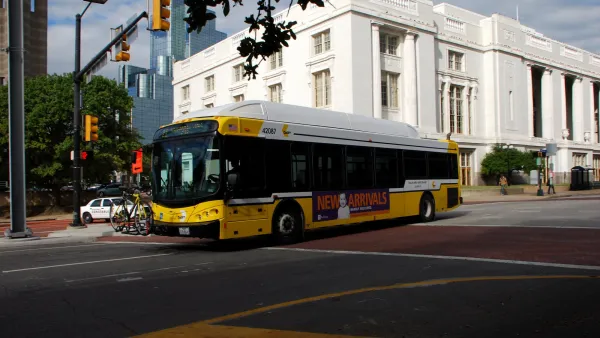
Dallas Bus System Overhaul Rolling Out in January. Will it Succeed?
The Dallas City Council recently approved a long-awaited and much-delayed bus system redesign for DART. Riders should require fewer transfers and shorter wait times starting in January 2022.

Tradeoffs Considered for Dallas-to-Plano Rail Line
Officials would like to speed up the arrival of the Cotton Belt—a planned rail line connecting Dallas to Plano—but that might require sacrificing service.

Dallas area transit prepares for World Cup, asks locals to drive
DART is adding a special shuttle service and creating back-up mechanisms to ensure it can serve all of this summer's World Cup attendees.

Planetizen Federal Action Tracker
A weekly monitor of how Trump’s orders and actions are impacting planners and planning in America.

The state-sanctioned urbicide of Austin
People don’t kill cities. Freeways do.

Colorado’s Largest Data Center Could Rise Next to Homes — Without a Public Hearing
The proposed campus would consume 11 times the power of Denver International Airport; as it has across the country, opposition mounts.

Nation's most wind-powered state turns to coal as data centers increase energy demand
For the first time in decades, Iowa has increased its generation of coal power.

NYC cools commuters with city's first rain garden above a bus stop
New York City officials say the plants in the rain garden can absorb 16 gallons of rainwater during heavy storms.

Brightline West’s future may rely on $6 billion federal loan
The company has until Nov. 2 to make a $400 million equity investment into its proposed high-speed rail line.

FREE Course: Walkable City 1: Why Walkability?
After describing his path towards focusing on walkability as the essence of good planning, Jeff Speck marches through his five principal reasons for making more walkable places.
Reinventing Malls: Planning Alchemy—Turning Gray Fields Into Gold
The course focuses on the opportunities and imperatives that shape reinvention of mall sites.

Greater Baltimore Committee
Eagle County Government
Harvard University Graduate School of Design
The Architects Foundation
University of Cincinnati Online
The Pocatello Development Authority
The Urban Renewal Agency of the City of Pocatello
Journal of the American Planning Association