A riverside neighborhood in Hamburg embraces flooding as part of its resilience planning, using old techniques to protect modern communities.


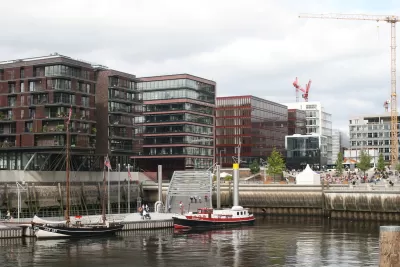
HafenCity, a development in the German port city of Hamburg, sits outside the city's main flood protection dike. Yet the community is being hailed as "a model for climate change resilience," writes Peter Yeung, thanks to its innovative use of centuries-old techniques that mitigate the effects of flooding, which is anticipated to become more severe as extreme weather worsens.
Rather than fight the flooding, some of HafenCity's structures, like the public promenades along the river and retrofitted brick warehouses, are built to withstand being flooded. "It’s a dramatic example of how a city can plan new development around the certainty of future flooding. While Hamburg sits more than 100 kilometers from the North Sea, its lowlands are vulnerable both to storm surges and heavy rainfall."
While most of the city is protected by a dike, HafenCity fell outside the area which could reasonably and affordably be integrated into the dike's domain. Its designers used another ancient Dutch technique: the terp. "Based on an ancient Dutch technique for building atop artificial mounds, the practice predates the modern era of seawalls" and promotes "[t]he concept of living with water rather than attempting to wall it off." The practice is also used in other parts of Hamburg to mitigate seasonal flooding. These strategies are coupled with a Storm Surge Warning Service that broadcasts announcements and provides information in the event of more unpredictable, catastrophic events.
Hamburg's success provides useful lessons for flood adaptation strategies that "focus on flexible, multi-use designs that are nature-based."
FULL STORY: In Hamburg, Surviving Climate Change Means Living With Water

Chicago's underground flood control system is almost full
The system known as Deep Tunnel has never filled much more than halfway, but the cumulative effect of recent rains is putting suburban communities at risk of flooding.

Atlanta Flood Prevention Efforts are Causing ‘Climate Gentrification’ in its Black Communities
New infrastructure in neighborhoods that have borne the brunt of seasonal floods is making them safer — and more expensive.

NYC’s Prospect Park is Getting a $68 Million ‘Bluebelt’
The city plans to upgrade the park’s drainage infrastructure to channel more stormwater into its lake and other drainage ponds and reduce flooding risk.

Planetizen Federal Action Tracker
A weekly monitor of how Trump’s orders and actions are impacting planners and planning in America.

The state-sanctioned urbicide of Austin
People don’t kill cities. Freeways do.

US to reduce Colorado River water deliveries to Mexico
A new Colorado Treaty amendment reduces Mexico’s Colorado River water allocation by 250,000 acre feet.

5 New England states march closer to 800 megawatt wind energy project
Securing federal approval for the project may be complicated under the Trump administration, which has historically been hostile towards domestic wind power.

Baltimore to break ground on $50 million Transit Priority Project
The project will bring faster bus trips, safer streets and better bike connections to Baltimore.

Airbnb launches $250 million 'last-dollar financing' housing accelerator, makes first investment in Austin
The company will put $6.4 million towards affordable housing development in Texas’ capital.

FREE Course: Walkable City 1: Why Walkability?
After describing his path towards focusing on walkability as the essence of good planning, Jeff Speck marches through his five principal reasons for making more walkable places.
Reinventing Malls: Planning Alchemy—Turning Gray Fields Into Gold
The course focuses on the opportunities and imperatives that shape reinvention of mall sites.


Eagle County Government
Harvard University Graduate School of Design
Nashville Planning Department
The Architects Foundation
University of Cincinnati Online
The Pocatello Development Authority
The Urban Renewal Agency of the City of Pocatello
Journal of the American Planning Association