New numbers from the Census Bureau show that fewer Americans moved in 2020 than ever before, belying dire predictions about the death of cities and the hollowing out of urban neighborhoods.


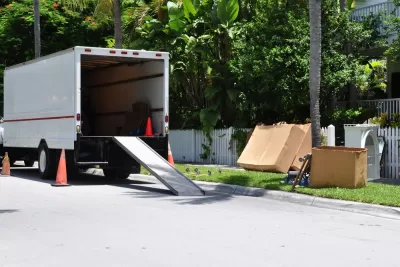
Despite the hype over a perceived 'urban exodus' due to COVID-19, Americans actually moved less in 2020, according to the Pew Research Center and data from the U.S. Census Bureau’s Current Population Survey. Richard Fry and D'Vera Cohn report that with only 8 percent of Americans making a move between March 2020 and March 2021, this is the lowest rate since the government started keeping records in 1948.
According to the article, "More people moved out of U.S. cities than moved into them," and "more people moved out of rural areas than moved into them in 2020." The only cities that experienced increased out-migration from previous years were New York and San Francisco. And while "suburbs had more people moving in from other U.S. communities than out," fewer Americans moved into suburban areas in 2020 than in prior years. The survey also indicates that people between 18 and 29 were most likely to move and that many pandemic moves were temporary.
The authors note that these numbers only reflect domestic migration and do not account for people moving in from abroad, or births and deaths. But the data runs counter to the popular narrative that Americans fled cities for lower-density communities in larger numbers during the pandemic.
Read the full story: In 2020, fewer Americans moved, exodus from cities slowed

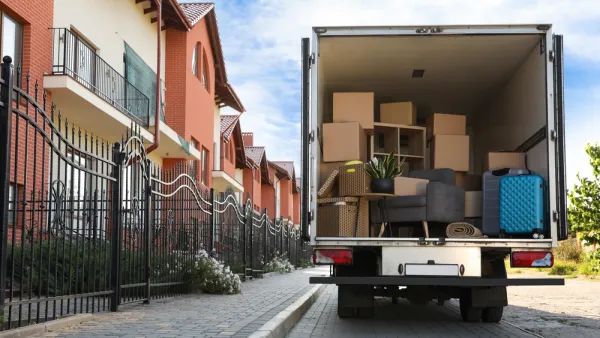
Low-Income Residents Less Likely to Move During the Pandemic, Freddie Mac Says
Does low-income residents staying put in large metro areas, relative to higher-income groups, mean that low-income households are missing out on affordable housing options? Freddie Mac researchers think so.
Report: Pandemic Migration Accelerated Existing Trends
Despite some transformative changes and brief spikes in domestic migration, the Covid-19 pandemic seems to be exacerbating existing declines in internal mobility.
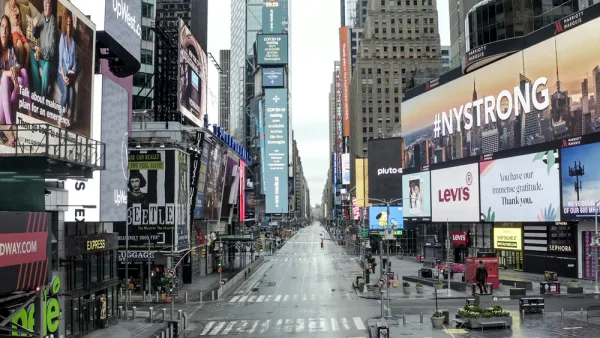
Pandemic-Era Big City Population Loss More Dramatic Than We Thought
A new analysis indicates that many big cities saw their biggest population declines in at least a decade, with suburbs also showing a slowdown in growth.

Planetizen Federal Action Tracker
A weekly monitor of how Trump’s orders and actions are impacting planners and planning in America.

Amtrak, CN end decades-long dispute with eight-year agreement
The new operating agreement establishes an updated framework for the companies to work together, including processes to resolve disputes.

Judges permit Denver to divert 77,000 acre feet from the Colorado River for reservoir expansion
Overuse and climate change have caused the Colorado River’s water levels to plummet.

Northwest rail fans eager for Sept. 30 debut of Amtrak’s Airo fleet
Get ready for that new train smell and more seats. But they won’t go faster or run more frequently on the Cascades route in Washington and Oregon.

NYC DOT wants faster, more permanent street upgrades
The city is examining ways to build more concrete infrastructure without getting entangled in 'decades-long' projects.

'Something we’ve never seen before:' rising utility rates could strain city finances nationwide
Data centers, climate change and other factors have caused utility rates in the United States to increase by 38% since 2020.

FREE Course: Walkable City 1: Why Walkability?
After describing his path towards focusing on walkability as the essence of good planning, Jeff Speck marches through his five principal reasons for making more walkable places.
Reinventing Malls: Planning Alchemy—Turning Gray Fields Into Gold
The course focuses on the opportunities and imperatives that shape reinvention of mall sites.

Harvard University Graduate School of Design
KFH Group Inc.
Greater Baltimore Committee
The Architects Foundation
University of Cincinnati Online
The Pocatello Development Authority
The Urban Renewal Agency of the City of Pocatello