The American Association of State Highway and Transportation Officials recently announced that the Utah Department of Transportation had won the "Quality of Life/Community Development" award. A social media pile on commenced.


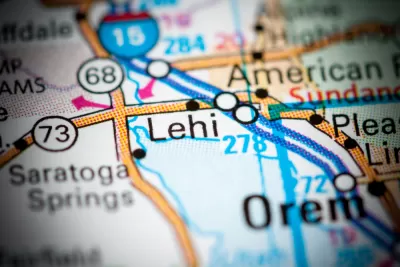
The Utah Department of Transportation completed a project in October 2020 that spent $415 million to widen Interstate 15 in the growing city of Lehi. The project, completed at a notorious bottleneck, added 17 bridges and new frontage roads for local traffic, along with transit access and improvements to a regional trail system. The trails that now connect through the area are part of a network that stretches from Salt Lake City to just outside of Provo.
The American Association of State Highway and Transportation Officials (AASHTO) announced on Twitter that the project had won the "Quality of Life/Community Development," award for a large project group on September 16, and the blowback was swift and vociferous.
According to an article by Ian Duncan about the project, the award, and the ensuing online controversy, the social media pile on "highlighted a core dispute about what role cars and highways should play in the future of transportation." That debate is all the more relevant given the ongoing debate at Congress for the Infrastructure Investment and Job Act as part of a larger $3.5 trillion budget package that at least starts a conversation about a new direction for U.S. transportation policy—even if it falls short of the hopes of many climate and transit advocates.
The article includes soundbites from planning luminaries Janette Sadik-Khan, Beth Osborne, and Charles Marohn. The former chimed in via Twitter:
"When a prize roadway project in the ‘Quality of Life/Community Development’ category shows signs of neither — not even a single person on foot, bike or transit — it deserves our scorn, not our praise,” wrote Janette Sadik-Khan, a former New York City transportation commissioner. “By these Orwellian standards, there is no such thing as traffic failure."
Zabe Bent, design director at the National Association of City Transportation Officials (NACTO), is also paraphrased in the article calling on planners to look beyond marginal improvements and rethink transportation systems in the face of climate change, racial injustice and soaring road deaths.
Accomplishing such a mode shift will require an uphill climb. States continue to expand highways and even the Infrastructure Investment and Jobs Act, touted as an milestone accomplishment of bipartisan cooperation, would spend "$350 billion for highways, about $107 billion for transit and $66 billion for rail," as noted by Duncan.
Marohn's soundbite describes that bill as "basically a highway bill with a veneer of handouts for everyone else to make the medicine go down easier."
FULL STORY: How a quality-of-life award for a 12-lane Utah highway sums up the debate over the future of transportation

Utah DOT Plans to Expand Interstate Despite Local Concerns
With more evidence pointing to the futility of expanding freeways, the state could take a creative approach to improving travel times and providing additional transportation options.
Three agencies expanding on-demand transit
Multiple states across America increasing access to flexible public transportation.
Another Reminder of the Futility of Carpool Lanes
What's the great 'fix' for the flawed Highway 101 carpool lanes in Marin and Sonoma counties in the Bay Area? Reduce the HOV time by two and a half hours during the peak commutes to enable solo drivers greater access to 52 miles of widened freeway.

Planetizen Federal Action Tracker
A weekly monitor of how Trump’s orders and actions are impacting planners and planning in America.

The state-sanctioned urbicide of Austin
People don’t kill cities. Freeways do.

US to reduce Colorado River water deliveries to Mexico
A new Colorado Treaty amendment reduces Mexico’s Colorado River water allocation by 250,000 acre feet.

5 New England states march closer to 800 megawatt wind energy project
Securing federal approval for the project may be complicated under the Trump administration, which has historically been hostile towards domestic wind power.

Baltimore to break ground on $50 million Transit Priority Project
The project will bring faster bus trips, safer streets and better bike connections to Baltimore.

Airbnb launches $250 million 'last-dollar financing' housing accelerator, makes first investment in Austin
The company will put $6.4 million towards affordable housing development in Texas’ capital.

FREE Course: Walkable City 1: Why Walkability?
After describing his path towards focusing on walkability as the essence of good planning, Jeff Speck marches through his five principal reasons for making more walkable places.
Reinventing Malls: Planning Alchemy—Turning Gray Fields Into Gold
The course focuses on the opportunities and imperatives that shape reinvention of mall sites.

Eagle County Government
Harvard University Graduate School of Design
Nashville Planning Department
The Architects Foundation
University of Cincinnati Online
The Pocatello Development Authority
The Urban Renewal Agency of the City of Pocatello
Journal of the American Planning Association