A new mayoral administration in Anchorage has its sights set on a revitalized urban core, but one local researcher has suggestions for how to expand that vision.


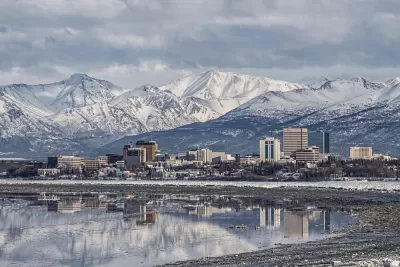
"A world-class urban center in Alaska’s largest city has long been the Holy Grail for Anchorage leaders," writes Jeanette Lee, senior researcher for Sightline, who worlds from Anchorage.
The city's new mayor, Dave Bronson, has prioritized investments in the downtown neighborhood of Anchorage in pursuit of that "holy grail," according to Lee. There's a lot going on in downtown Anchorage—during the summer. "What no one has managed to figure out, though, is how to keep the downtown economy humming like it’s always the peak of summer, when office workers, other Alaskans, and tourists are dining out, buying things, and paying for lodging in the downtown core," writes Lee.
Since his transition into office, Mayor Bronson has focused on downtown as a key driver of economic revitalization: "His team wants a vibrant year-round business environment and intends to focus on supporting tourism, filling office space, and boosting retail sales." Lee suggests, however, that Bronson needs to be more ambitious in attracting new residents to downtown—a trend toward urban population growth that has skipped over Anchorage while changing the face of many downtowns around the country.
High construction costs are the primary hurdle facing the task of adding more residential population—not demand—according to Lee.
The city has put in place some policies to encourage housing downtown, including tax abatement and letting developers choose how much parking to build, but it can do more. A few suggestions include partnering with developers to invest in projects; incentivizing housing builds on downtown’s numerous surface parking lots and other underdeveloped properties; mitigating offsite construction costs; zoning reform; and attracting foundational neighborhood businesses, like a grocery store.
Lee provides a lot more detail on the challenges facing a downtown revitalization in Anchorage. Drilling down on each of the earlier and suggested actions listed in the preceding paragraph.
Read the full story: Let There Be Housing in Anchorage
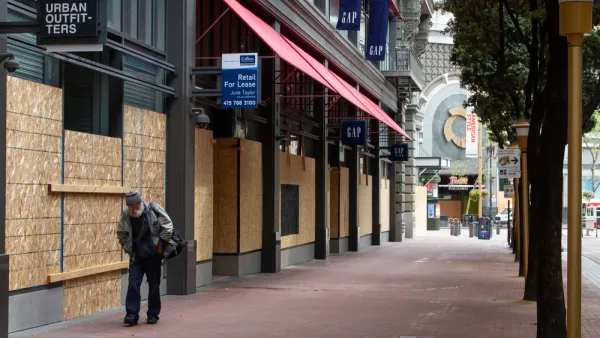
A ‘Public Realm Action Plan’ Charts San Francisco’s Post-Covid Comeback
A nonprofit business group released a plan to trigger the post-pandemic revitalization of Downtown San Francisco by reclaiming public space for human scale activity. But is an improved public realm sufficient to meet the challenge?
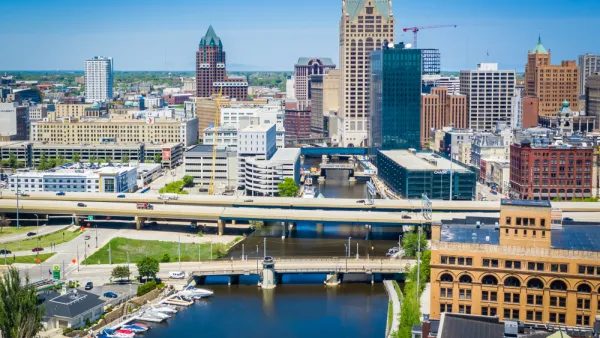
Project Team for Milwaukee's New Downtown Area Plan Takes Shape
A new plan for Milwaukee's downtown will build on a "major renaissance" in the area since the approval of the last version of the plan in 2010.
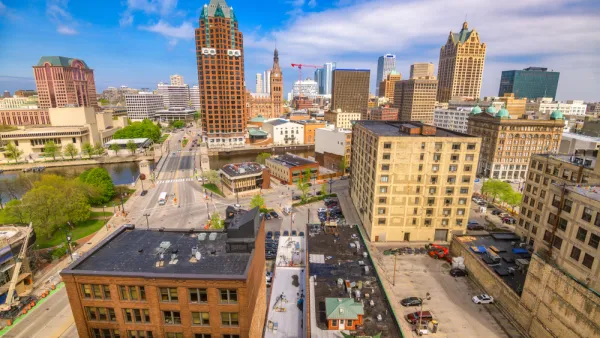
Downtown Milwaukee Area Plan Update Kicks Off
Billions of dollars in investment and thousands of new residential units later, Milwaukee is ready to update the plan for its downtown.

Planetizen Federal Action Tracker
A weekly monitor of how Trump’s orders and actions are impacting planners and planning in America.

California plans to bury El Niño’s downpour
If the state plays its cards right, it may be able to store a billion acre-feet of El Niño’s water in aquifers.

Desperate measures: Advocates weigh draining Lake Powell to fill Colorado River
Draining the reservoir could reduce evaporation losses by a couple hundred thousand acre-feet.

Mamdani’s pied-à-terre tax survives legal challenge
A panel of judges found that the plaintiffs failed to demonstrate injury as a result of New York City's implementation of the tax.

Eastern Nebraska is running out of electricity
Data centers and electrification are straining eastern Nebraska’s grid, throttling economic development.

Seattle passes record-breaking transit services expansion
Proposition 1 will double the city’s transit tax to add 95,000 more bus trips and preserve 180,000 bus trips annually.

FREE Course: Walkable City 1: Why Walkability?
After describing his path towards focusing on walkability as the essence of good planning, Jeff Speck marches through his five principal reasons for making more walkable places.
Reinventing Malls: Planning Alchemy—Turning Gray Fields Into Gold
The course focuses on the opportunities and imperatives that shape reinvention of mall sites.

City of Rosemead
Rutgers University, Edward J. Bloustein School of Planning and Public Policy
One Hundred Miles
University of Michigan School for Environment and Sustainability (SEAS)
Hunter College, City University of New York (CUNY)
The Architects Foundation
City of Cambridge
Montrose County
The Pocatello Development Authority