Using a series of mid-century guidebooks, a new project seeks to uncover historic LGBTQ spaces around the country.


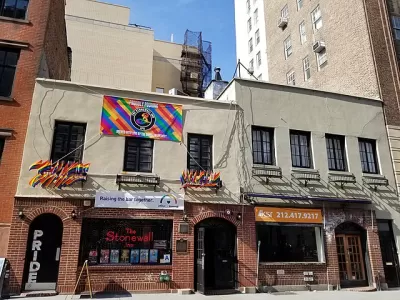
Eric Gonzaba, a historian and professor at California State University, Fullerton (CSUF), has launched a project aimed at "uncovering and preserving hidden histories" in the LGBTQ community as presented in "a series of travel guides published by Bob Damron to map historic queer spaces across the United States," also known as the 'Gay Guides.'
As Marianne Dhenin writes in Next City, the guides were produced by Bob Damron, "a traveling businessman who took note of the gay or at least gay-friendly bars, bathhouses, theaters, bookstores, restaurants, and shops he discovered on his many trips." Now, Mapping the Gay Guides has made the guides into an interactive map loaded with information about important sites and its importance in gay history.
Since its launch in February 2020, Mapping the Gay Guides has dropped hundreds of pins on its interactive map across all 50 states, Washington D.C., Guam, Puerto Rico, and the Virgin Islands (Damron did not distinguish between entries in the U.S. Virgin Islands and the British Virgin Islands, so neither does Mapping the Gay Guides) from the 1965 to 1980 address books. The project received a $350,000 grant from the National Endowment for the Humanities (NEH) in April 2021, which will allow it to spend the next three years digitizing, transcribing, and geolocating data from the 1981 to 2000 guides.
In working on the project, Gonzaba also felt motivated by "a fairly depressing moment in queer communities across the country dealing with the collapse of LGBTQ spaces" as many businesses shuttered, some permanently, during the pandemic. But he cautions that understanding the context of the guides matters: they "were authored by a gay, white man from the relatively progressive city of San Francisco" with his own biases. "Mapping the Gay Guides exemplifies the many colorful possibilities of a digital history project handled with appropriate care. Like other creative digital projects, it can give users a fresh perspective on their cities" and uncover hidden and suppressed histories.
Read the full story: A New Project Is Bringing the Gay ‘Green Book’ Online


In the 1990s, Kansas City's Womontown offered queer women community and independence
A group of women created a safe space that gave them the opportunity to buy homes and build wealth in a supportive community.
Portland unveils Maine’s first affordable housing complex for LGBTQ+ seniors
The building earmarks 11 units for people with disabilities or living with HIV/AIDS.
Thrift stores, public libraries and genderless bathrooms: How public amenities become trans infrastructure
Amenities like ample public transit, affordable retail and non-gendered bathroom spaces can make cities more safe and welcoming for transgender residents — and everyone else.

Planetizen Federal Action Tracker
A weekly monitor of how Trump’s orders and actions are impacting planners and planning in America.

The state-sanctioned urbicide of Austin
People don’t kill cities. Freeways do.

Colorado’s Largest Data Center Could Rise Next to Homes — Without a Public Hearing
The proposed campus would consume 11 times the power of Denver International Airport; as it has across the country, opposition mounts.

Nation's most wind-powered state turns to coal as data centers increase energy demand
For the first time in decades, Iowa has increased its generation of coal power.

NYC cools commuters with city's first rain garden above a bus stop
New York City officials say the plants in the rain garden can absorb 16 gallons of rainwater during heavy storms.

Brightline West’s future may rely on $6 billion federal loan
The company has until Nov. 2 to make a $400 million equity investment into its proposed high-speed rail line.

FREE Course: Walkable City 1: Why Walkability?
After describing his path towards focusing on walkability as the essence of good planning, Jeff Speck marches through his five principal reasons for making more walkable places.
Reinventing Malls: Planning Alchemy—Turning Gray Fields Into Gold
The course focuses on the opportunities and imperatives that shape reinvention of mall sites.


Greater Baltimore Committee
Eagle County Government
Harvard University Graduate School of Design
The Architects Foundation
University of Cincinnati Online
The Pocatello Development Authority
The Urban Renewal Agency of the City of Pocatello
Journal of the American Planning Association